45 mins to read
3+ lessons

Sales Prospecting

Modern B2B sales prospecting is no longer just about finding a list of names and sending cold emails.

Top-performing sales teams combine accurate contact data, company intelligence, CRM enrichment, buyer intent signals, AI-assisted research, and multi-channel outreach to identify the right buyers and turn more conversations into qualified sales pipeline.

This guide walks through the complete modern sales prospecting process, from defining your ideal customer profile to finding decision-makers, enriching your CRM, prioritizing accounts, launching cadences, and measuring revenue impact.

Sales Prospecting Guide

Intro to Prospecting


SDRs, account executives, sales leaders, founders, marketers, or revenue operations professionals, this prospecting hub is for you.

It's here to help you build a more predictable B2B prospecting growth engine.

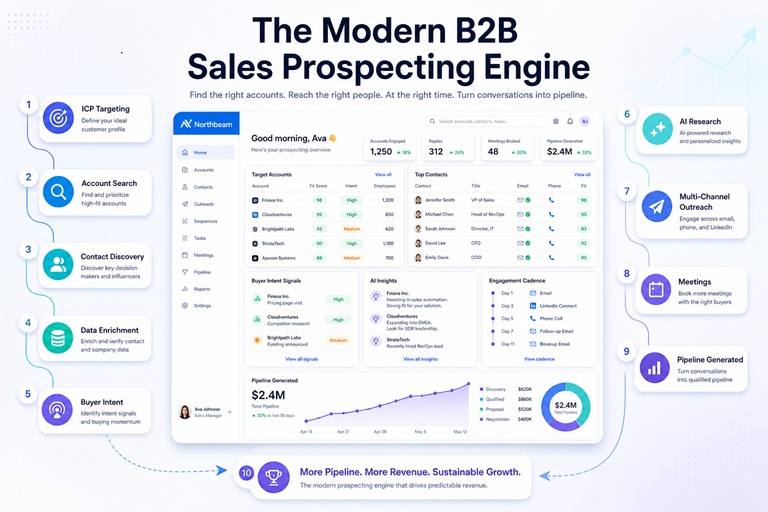
Modern B2B Sales Prospecting Flow

What you’ll learn how to do:

  • Define your ideal customer profile and target personas
  • Find companies and contacts that match your best-fit buyers
  • Use email, phone, and company data to improve outreach accuracy
  • Enrich CRM records for better segmentation and reporting
  • Use buyer intent data to prioritize in-market accounts
  • Apply AI to speed up research, personalization, and list building
  • Build multi-channel prospecting sequences
  • Measure prospecting success using pipeline-focused KPIs
  • Use Seamless.AI to find, enrich, and engage better prospects faster
Prev
Prev Text
Next
Next Text
Table of Contents

How About 50 Free Credits?

Don’t wait until you run out of sales leads. Try Seamless.AI for free today and find your next big opportunity.

By submitting this form, you agree to our Terms of Use, Privacy Policy, and consent to receiving marketing communications from us.

Thank you! Your submission has been received!
Oops! Something went wrong while submitting the form.
Sales Prospecting

What Is B2B Sales Prospecting

What is sales prospecting

Sales prospecting is the process of identifying, researching, qualifying, and contacting potential buyers who may be a good fit for your product or service.

In B2B sales, prospecting usually involves finding companies that match your ideal customer profile, identifying the right decision-makers or influencers at those companies, collecting accurate contact information, and reaching out with relevant messaging.

Why is sales prospecting important?

Sales prospecting is one of the first steps in creating new pipeline.

It gives sales teams a proactive way to start conversations with potential customers instead of relying only on inbound leads, referrals, or existing demand.

What tasks does sales prospecting include?

A strong sales prospecting process typically includes:

  • Identifying target accounts
  • Finding decision-makers and stakeholders
  • Researching company needs, priorities, and buying signals
  • Finding verified emails, direct dials, and other contact details
  • Enriching account and contact records in the CRM
  • Prioritizing prospects based on fit, timing, and intent
  • Reaching out through email, phone, LinkedIn, and other channels
  • Tracking activity, engagement, meetings, opportunities, and pipeline
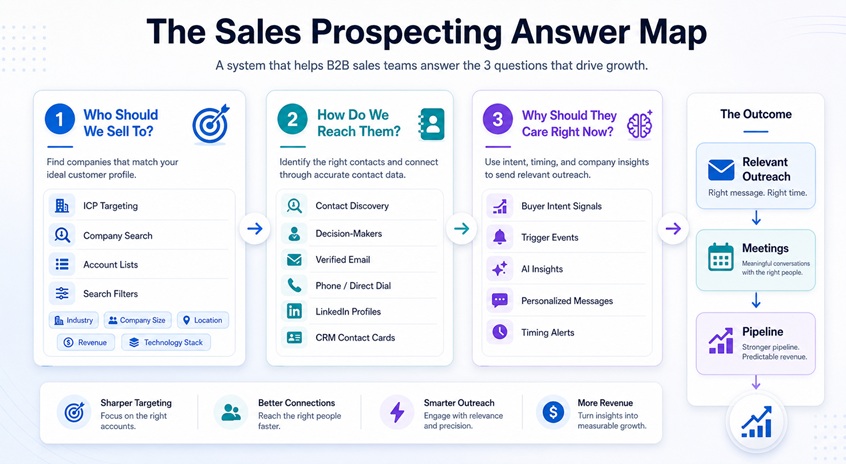
Sales Prospecting Answer Map

At its best, sales prospecting helps revenue teams answer three important questions:

  1. Who should we sell to?
  2. How do we reach them?
  3. Why should they care right now?

Seamless CRM tools can helps sales teams answer those questions by making it easier with the power of AI to search for companies and contacts, find accurate contact data, enrich records, and build prospect lists for outbound sales campaigns.

Related: Learn more about Sales Prospecting?

Sales Prospecting

Why Prospecting Matters in Modern B2B Sales

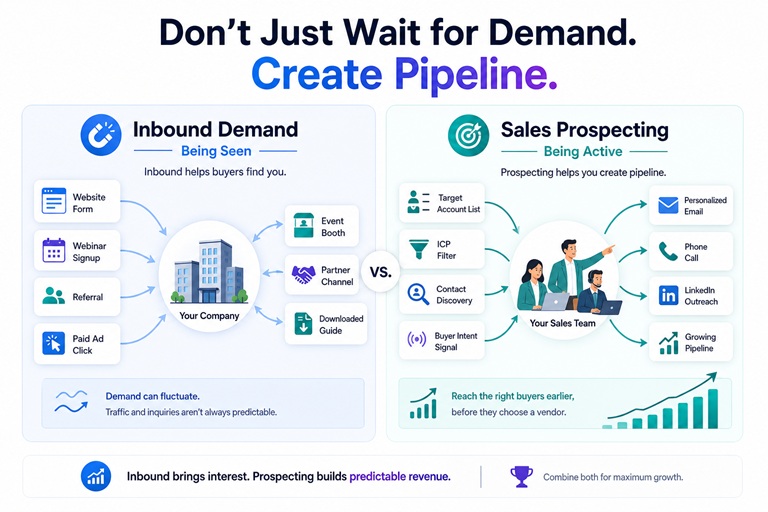
Why Prospecting Matters in Modern B2B Sales

Inbound marketing, referrals, events, paid media, and partner channels are all valuable sources of demand. But for many B2B companies, inbound demand alone is not enough to build predictable revenue growth.

Sales prospecting gives teams a way to proactively create pipeline and project growth despite market trends or demand changes.

Instead of waiting for buyers to discover your company, prospecting allows sales teams to identify the accounts they want to win and start relevant conversations with the people most likely to influence or make purchasing decisions.

Being active vs being seen

Modern B2B prospecting tactics matter because it helps teams get more out of their product:

  • Build predictable outbound pipeline
  • Reach new markets and territories
  • Break into named target accounts
  • Support account-based sales and marketing motions
  • Create conversations with buyers before they submit a form
  • Fill gaps when inbound demand slows
  • Improve territory coverage and sales productivity
  • Focus reps on companies that match the ideal customer profile

Prospecting is especially important in competitive markets where buyers may not actively search for a new vendor until they already have a shortlist.

When the time comes that a prospect requests a demo, they may have already researched competitors, evaluated alternatives, and formed opinions.

Effective prospecting helps sales teams reach buyers earlier in the journey with helpful, relevant, and timely outreach.

The challenge is that old-school prospecting methods are no longer enough. Generic lists, outdated contact information, mass emails, and one-size-fits-all messaging lead to poor reply rates and wasted rep time.

Modern sales prospecting requires better data, stronger targeting, smarter prioritization, and more personalized execution. Teams that need data accuracy rely on Seamless.

Seamless is real-time AI powered company and contact search engine with complete sales intelligence and prospecting outreach built-in to make sales teams more efficient and generate better ROI. Talk to a rep today.

Sales Prospecting

Prospecting vs. Lead Generation vs. Sales Qualification

Prospecting vs. Lead Generation vs. Sales Qualification

Sales prospecting is often used interchangeably with lead generation and qualification, but they are not exactly the same.

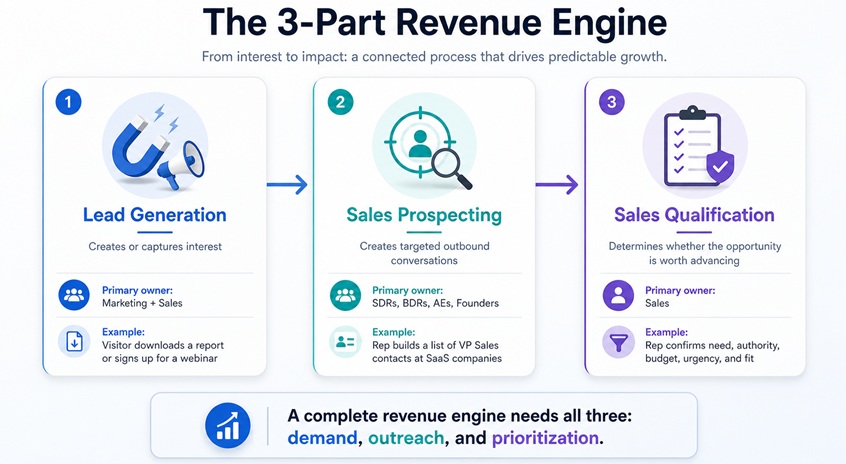
3-part Revenue Engine

Concept What It Means Primary Owner Example
Lead generation Attracting potential buyers through marketing, campaigns, content, events, referrals, or other demand channels Marketing and sales A visitor downloads a report or signs up for a webinar
Sales prospecting Actively finding and contacting potential buyers who match your ICP SDRs, BDRs, AEs, founders, sales teams A rep builds a list of VP Sales contacts at SaaS companies
Sales qualification Determining whether a lead or prospect is a strong fit and worth pursuing Sales A rep confirms need, authority, budget, urgency, and fit

Put simply:

  • Lead generation > creates or captures interest.
  • Sales prospecting > creates targeted outbound conversations.
  • Qualification > determines whether the opportunity is worth advancing.

A complete revenue engine usually needs all three.

Marketing generates demand, sales prospecting creates new outbound opportunities, and qualification ensures sales teams prioritize the best-fit buyers.

Seamless enriches existing CRM data for GTM teams to improve targeting and accuracy to ensure the TAM is address.

Sales Prospecting

The Modern B2B Sales Prospecting Process

The Modern B2B Sales Prospecting Process

A strong B2B sales prospecting process is structured, repeatable, and measurable. The goal is not just to contact more people.

The goal is to contact the right people with the right message at the right time.

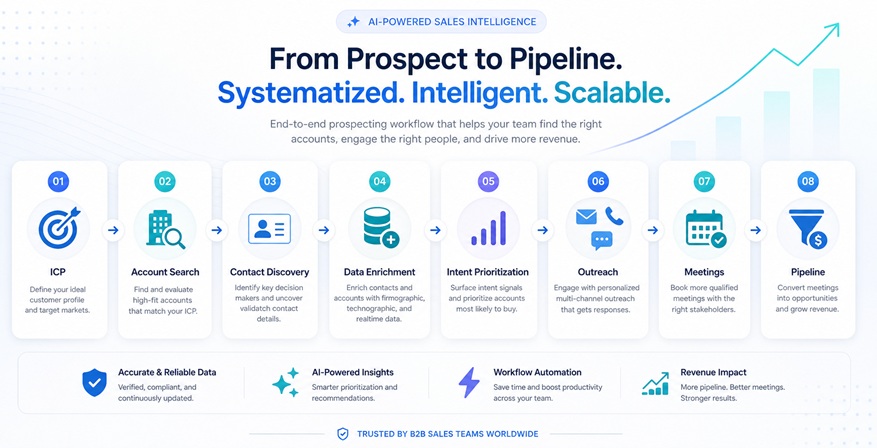
Sales prospecting workflow

A modern prospecting workflow typically follows these steps:

  1. Define your ideal customer profile
  2. Identify target accounts
  3. Find the right contacts and decision-makers
  4. Verify emails, phone numbers, and company information
  5. Enrich CRM records with missing data
  6. Prioritize accounts using fit, triggers, and intent signals
  7. Personalize outreach based on role, company, and need
  8. Launch multi-channel sales cadences
  9. Track activity, engagement, meetings, and pipeline
  10. Optimize based on conversion data

A simple 3 approach way to think about the process is: Find, Connect, and Close

Here's how to apply this approach into modern B2B sales workflows.

Sales Prospecting Process Infographic

ICP → Account Search → Contact Discovery → Data Enrichment → Intent Prioritization → Outreach → Meetings → Pipeline

The better each stage works, the stronger the entire prospecting motion becomes.

For example, if your ICP is too broad, your team may waste time on accounts that are unlikely to buy. If your contact data is outdated, reps may deal with bounced emails and disconnected phone numbers. If your messaging is generic, prospects may ignore outreach even if they are a good fit.

Modern prospecting is about improving every step of the workflow so reps can spend less time researching and more time creating meaningful sales conversations.

Learn how Seamless can Connect this process together into one workflow designed around goal-oriented sales teams.

Sales Prospecting

Step 1: Start with Your Ideal Customer Profile

Step 1: Find ICP

Effective prospecting starts with knowing who you want to reach.

Your ideal customer profile, or ICP, defines the types of companies that are most likely to buy, succeed with, and expand from your product or service. Without a clear ICP, sales teams often cast too wide of a net and end up pursuing accounts that are unlikely to convert.

Let's breakdown the most important elements to help you prioritize and analyze.

A strong ICP may include criteria such as:

  • Industry
  • Company size
  • Annual revenue
  • Geography
  • Growth stage
  • Funding status
  • Technology stack
  • Department size
  • Hiring activity
  • Business model
  • Pain points
  • Buying triggers
  • Regulatory or operational requirements

Once you define the company profile, you also need to define the buyer personas inside those accounts.

Persona criteria may include:

  • Job title
  • Seniority level
  • Department or function
  • Responsibilities
  • Goals and KPIs
  • Common pain points
  • Buying influence
  • Objections
  • Preferred communication channels

For example, a B2B SaaS company selling sales technology might target:

  • U.S.-based companies with 100 to 1,000 employees
  • Sales teams using Salesforce or HubSpot
  • Companies hiring SDRs, BDRs, or account executives
  • Organizations with a dedicated revenue operations function
  • Contacts such as CROs, VPs of Sales, SDR Directors, and RevOps leaders

The more specific your ICP and personas are, the easier it becomes to build targeted prospect lists, write relevant messaging, and prioritize accounts that are more likely to convert.

A clear ICP also helps align sales, marketing, customer success, and revenue operations around the same definition of a high-quality opportunity.

Sales Prospecting

Step 2: Finding the Right Sales Prospects

Step 2: Finding the Right Sales Prospects

Once your ideal customer profile is clearly defined from the first step, the next step is finding companies and contacts that match those criteria.

This is where many prospecting strategies either gain momentum or lose valuable time.

When sales teams rely on manual research, outdated spreadsheets, or incomplete CRM records, reps can spend hours searching for prospects before they ever send an email, make a call, or start a meaningful conversation.

Modern prospecting tools make this process faster, more accurate, and more scalable.

Instead of guessing which accounts might be a good fit, sales teams can search using company details, contact information, job roles, and buying signals to build highly targeted prospect lists.

This allows reps to focus their time on the accounts most likely to need their solution.

Company-level search criteria are often the first step

These types of filters help identify accounts that align with your ICP based on factors such as industry, company size, revenue range, headquarters location, geographic market, technology used, funding history, hiring activity, department growth, company type, and relevant keywords.

For example, rather than broadly targeting “software companies,” a sales rep could search for “B2B SaaS companies in the United States with 100–500 employees that are hiring sales development representatives.” That level of detail creates a much more focused list and helps ensure outreach is relevant from the start.

After identifying the right companies, the next step is finding the right people inside those organizations.

Contact-level search criteria are next on deck

Contact-level search criteria can include job title, seniority, department, function, location, email availability, phone availability, LinkedIn profile, and role-related keywords.

The best contact will depend on the product, sales process, and buying committee.

In some organizations, the CFO may be the final decision-maker. In others, a director, manager, or operations leader may be the internal champion who understands the day-to-day challenge.

A strong prospecting list often includes multiple stakeholders within each account, including decision-makers, influencers, users, and department leaders.

Sales teams can also improve prospecting results by paying attention to trigger events and buying signals. These are business changes that suggest a company may be more open to a timely conversation.

Examples include new funding, executive hires, rapid headcount growth, expansion into new markets, product launches, mergers and acquisitions, technology changes, hiring for roles related to your solution, new compliance needs, or buyer intent around relevant topics.

Trigger-based prospecting gives reps a stronger reason to reach out. Instead of sending a generic message like, “I wanted to introduce our company,” reps can connect their outreach to a real business event or priority.

To build more targeted prospect lists faster, sales teams can search millions of companies and contacts with Seamless.

Sales Prospecting

Step 3: Use Buyer Intent Data to Prioritize the Right Prospects

Step 3: Use Buyer Intent Data to Prioritize the Right Prospects

Not every good-fit account is ready to buy right now. That is why buyer intent data is a valuable part of modern sales prospecting.

Buyer intent data helps sales teams identify companies that may be actively researching topics, challenges, or solutions related to what they sell.

When used correctly, this data allows reps to focus their time on accounts that may be more likely to engage, instead of treating every prospect with the same level of urgency.

Intent data can help sales teams identify accounts showing interest in relevant topics, prioritize outreach based on timing, personalize messaging around current pain points, and align sales and marketing around the same target accounts.

It can also make outbound prospecting more efficient by helping reps focus on warmer opportunities and improve account-based sales campaigns.


For example, a company selling CRM enrichment software may want to prioritize prospects showing interest in topics such as CRM data enrichment, B2B contact databases, sales prospecting software, data hygiene, revenue operations tools, or sales intelligence platforms.

These signals can suggest that a company is actively exploring challenges or solutions that connect to the product being offered.

However, buyer intent data should not replace your ideal customer profile.

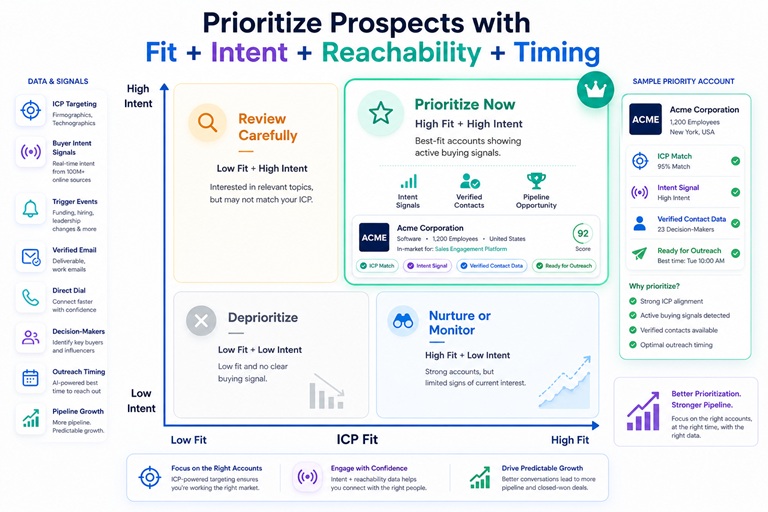
A company may be researching a relevant topic but still be too small, too large, outside your target geography, or otherwise not a strong match for your solution. The best prospecting strategy combines multiple factors: fit, intent, reachability, and timing.

When an account matches your ICP, has relevant decision-makers, shows signs of interest, and can be reached with accurate contact data, your sales team has a much stronger prospecting opportunity.

Combining buyer intent with accurate company and contact information means reps can prioritize better accounts, create more relevant outreach, and increase their chances of starting meaningful sales conversations.

Learn more about how Seamless helps sales teams identify and prioritize better-fit prospects.

Sales Prospecting

Step 4: Improve Outreach with Data Accuracy

Step 4: Improve Outreach with Data Accuracy

Data quality plays a major role in sales prospecting success.

Even the strongest messaging can fall flat if reps are working with outdated emails, incorrect phone numbers, missing job titles, duplicate records, or incomplete company information.

Poor data creates friction across the entire sales process. Emails bounce, calls go to the wrong people, reps waste time doing manual research, CRM segmentation becomes unreliable, outreach is sent to the wrong persona, and pipeline reporting becomes less accurate.

Use Contact Data and Enrichment to Improve Prospecting Accuracy

Accurate contact and company data helps sales teams improve reachability, personalization, segmentation, and reporting.

Important prospecting data includes contact names, job titles, seniority, departments, company names, websites, industries, employee counts, revenue ranges, locations, business emails, direct dials, LinkedIn profiles, technology data, CRM ownership, and the last updated or verified date.

When this information is complete and current, reps can prioritize better-fit accounts, personalize their outreach, and spend more time selling instead of searching.

An email finder helps sales teams identify business email addresses for prospects, making it easier to run outbound campaigns, execute account-based outreach, follow up after events, and build targeted sales sequences.

However, teams should use email data responsibly by following applicable laws, platform rules, and deliverability best practices. This includes honoring opt-out requests, avoiding misleading messaging, and maintaining clean sending habits.

Phone data is also valuable, especially in B2B sales motions where direct conversations can accelerate pipeline. Direct dials can help reps reach decision-makers faster, particularly when email inboxes are crowded.

Phone prospecting is especially useful for high-value accounts, executive outreach, follow-up after email engagement, event or webinar follow-up, time-sensitive buying signals, and territory-based outbound campaigns.

CRM enrichment is another important way to improve prospecting accuracy.

Enrichment adds missing or updated data to existing CRM records, making those records more useful for sales and marketing teams.

It can improve lead routing, account scoring, personalization, segmentation, territory planning, reporting, duplicate management, and sales and marketing alignment.

For example, if a CRM record includes a contact name and company but is missing the job title, phone number, employee count, or industry, enrichment can turn that incomplete record into actionable sales intelligence.

When sales teams combine accurate prospecting criteria with high-quality contact data and CRM enrichment, they can work more efficiently, reach the right people faster, and create more relevant outreach.

Better data leads to better conversations, and better conversations create more opportunities.

To improve prospecting accuracy and keep your CRM up to date, enrich your contact and company data with Seamless.

Sales Prospecting

How AI Is Changing Sales Prospecting

How AI Is Changing Sales Prospecting

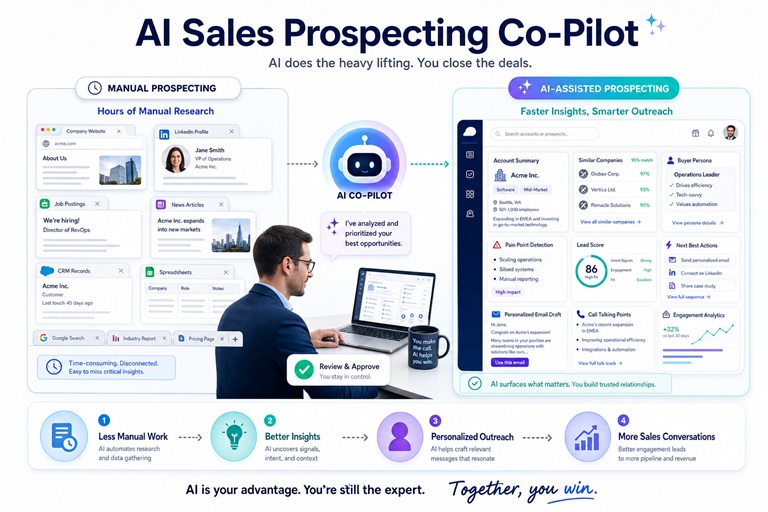
AI is transforming the way sales teams research, prioritize, and engage with prospects.

Instead of spending hours digging through websites, LinkedIn pages, job postings, news articles, and CRM records, reps can use AI-assisted workflows to gather insights faster and identify better outreach opportunities. The goal of AI in sales prospecting is not to replace salespeople. The goal is to reduce repetitive manual work so reps can spend more time on high-value activities like personalization, discovery, conversations, and relationship-building.

AI can support prospecting in many useful ways.

It can help sales teams research accounts faster, summarize company information, identify similar companies, suggest relevant buyer personas, build targeted prospect lists, and draft personalized email copy.

AI can also create call talking points, highlight possible pain points, analyze engagement patterns, support lead scoring, and recommend next best actions. These capabilities help reps move from basic research to meaningful outreach more quickly.

For example, rather than manually reviewing a company’s website, recent news, hiring activity, and social presence, a rep can use AI to summarize key account insights and uncover possible reasons to reach out. This makes it easier to understand what may be happening inside an account and how a product or service could connect to the prospect’s current priorities.

AI can also help sales teams personalize outreach at scale. Instead of sending the same message to every prospect, reps can tailor their messaging based on job title, industry, company size, technology stack, recent business changes, or likely pain points.

This allows outreach to feel more relevant while still helping teams work efficiently across larger prospect lists.

However, AI-generated content should always be reviewed by a human. The best sales outreach is accurate, relevant, credible, and thoughtful. Reps should avoid over-automation, unsupported claims, and generic AI-written messages that feel impersonal.

AI is most effective when it supports the salesperson’s judgment, not when it replaces it.

Used well, AI helps modern sales teams move faster without sacrificing quality. It gives reps better insights, sharper messaging, and more time to focus on the conversations that create pipeline and build lasting customer relationships.

Related: AI in Sales 2026 Report

Sales Prospecting

How to Build a High-Quality Prospect List

How to Build a High-Quality Prospect List

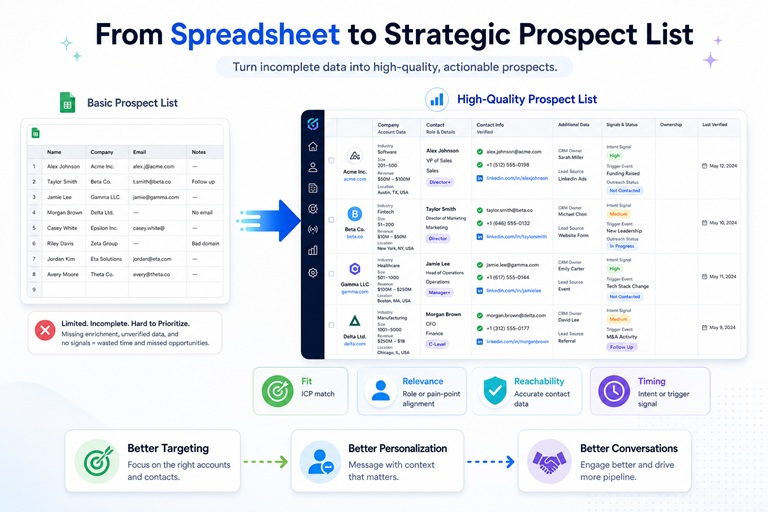
A prospect list is more than a spreadsheet filled with names and companies.

A high-quality prospect list is a focused collection of target accounts and contacts that match your ideal customer profile, can be reached through accurate contact information, and have a relevant reason to hear from your team.

When built correctly, a prospect list becomes a strategic sales asset that helps reps spend less time searching and more time connecting with the right buyers.

A strong prospect list should include the key details sales teams need to research, prioritize, personalize, and track outreach.

This often includes company name, website, industry, company size, revenue range, location, contact name, job title, department, seniority, email address, phone number, LinkedIn profile, CRM account owner, lead source, intent or trigger signal, outreach status, and the last verified date.

The more complete and accurate this information is, the easier it becomes for reps to understand who they are contacting, why the account matters, and how to tailor their message.

A helpful framework for evaluating prospect list quality is: fit, relevance, reachability, and timing.

  • Fit means the account matches your ICP and has the right characteristics for your product or service.
  • Relevance means your outreach connects to the prospect’s role, industry, goals, or pain points. Reachability means you have accurate emails, phone numbers, LinkedIn profiles, or other contact details that allow your team to engage.
  • Timing means there is a trigger event, buyer intent signal, company change, or business reason to start the conversation now. When all four elements work together, prospecting becomes more targeted and effective.

For example, a SaaS sales team might build a list of recently funded B2B software companies with 100–500 employees that are hiring SDRs and using Salesforce. A recruiting firm may focus on fast-growing technology companies hiring for engineering, sales, or customer success roles.

The more targeted your prospect list is, the easier it becomes to write outreach that feels timely, useful, and relevant to the buyer. Instead of sending generic messages to broad audiences, sales teams can use high-quality prospect lists to prioritize better-fit accounts, personalize their communication, and increase the chances of turning cold outreach into meaningful conversations.

Seamless automates list-building with the help of AI in Autopilot. Click a button to let AI build your perfect ICP list.

Sales Prospecting

Create Sales Sequences and Cadences That Convert

Create Sales Sequences and Cadences That Convert

A sales cadence is a structured series of outreach touchpoints designed to engage a prospect over time.

In most cases, prospects will not respond to a single email or one phone call. They may be busy, traveling, focused on other priorities, or simply not ready to engage the first time they hear from your team. That is why a well-planned cadence is so important.

An effective sales cadence uses multiple channels, such as email, phone, and LinkedIn, to create familiarity and increase the chances of starting a meaningful conversation. Rather than relying on one generic message, a strong cadence gives sales reps several opportunities to deliver value, reference relevant business needs, and connect with prospects in a professional way.

For example, a prospecting cadence may begin with a personalized email that introduces a relevant problem or opportunity. A few days later, the rep might engage on LinkedIn, make a phone call, leave a short voicemail if appropriate, and follow up with a useful insight, customer outcome, or use case. Over time, these touchpoints help the prospect understand why the outreach matters and how the conversation could be valuable.

The right cadence will depend on several factors, including your industry, deal size, buyer persona, sales cycle, and compliance requirements. A cadence for enterprise executives may look different from one designed for small business owners or mid-market department leaders. The key is to create a process that is consistent enough to scale, but flexible enough to feel relevant to each prospect.

To improve cadence performance, sales teams personalize outreach based on the prospect’s role, company, and any relevant trigger events.

  • Emails should be concise, clear, and easy to respond to.
  • Messaging should lead with the buyer’s problem or priority, not a heavy product pitch.
  • Reps should also vary their outreach channels instead of relying only on email, use direct dials when available, and test different subject lines, calls to action, and value propositions.

It is also important to respect prospect preferences and maintain clean sales processes. Outreach should stop when a prospect opts out, and all activity should be updated in the CRM so teams have accurate visibility into engagement. Reviewing cadence performance by persona, segment, and message can help sales leaders understand what is working and where improvements are needed.

The goal of a sales cadence is not to overwhelm prospects. The goal is to create relevant, timely, and professional follow-up that helps your team build trust, stay top of mind, and open the door to better sales conversations.

Example Sales Prospecting Cadence

                                                                                                                                                                                                                       
DayChannelAction
Day 1EmailSend a personalized value-based opener.
Day 2LinkedInView the prospect’s profile or send a connection request.
Day 3PhoneCall and leave a short voicemail if appropriate.
Day 5EmailShare a relevant insight, use case, or customer outcome.
Day 7PhoneFollow up with a second call attempt.
Day 10LinkedInEngage with the prospect’s content or send a short message.
Day 14EmailSend a final value-based follow-up or breakup email.
Sales Prospecting

How to Measure Sales Prospecting Performance

How to Measure Sales Prospecting Performance

Sales prospecting should be measured by more than activity volume.

While calls made, emails sent, and new contacts added are useful indicators, they do not tell the full story.

A sales team can generate a high number of activities and still produce low-quality pipeline if the targeting is too broad, the contact data is inaccurate, or the messaging does not connect with the buyer’s needs.

A stronger approach is to measure prospecting performance across three key levels: activity metrics, engagement metrics, and revenue metrics. Together, these measurements help sales leaders understand not only whether prospecting work is happening, but also whether that work is reaching the right people, creating meaningful conversations, and turning into real business opportunities.

Activity metrics show whether prospecting efforts are being executed consistently. These may include prospects added, accounts researched, emails sent, calls made, LinkedIn touches, cadence enrollments, and CRM records enriched. These metrics are helpful for managing productivity and making sure reps are taking action. However, activity alone should not be treated as the final measure of success. More activity does not always mean better results.

Engagement metrics show whether prospects are responding to outreach. These may include email bounce rate, email open rate, reply rate, positive reply rate, call connect rate, voicemail response rate, LinkedIn acceptance rate, and meeting booking rate. Engagement metrics are especially useful because they reveal whether your team is reaching the right audience with accurate data and relevant messaging. For example, a high bounce rate may point to poor data quality, while a low reply rate may suggest that the message, offer, or target persona needs improvement.

Revenue metrics connect prospecting efforts to business outcomes. These may include meetings booked, meeting show rate, opportunities created, pipeline generated, opportunity conversion rate, average deal size, win rate, closed-won revenue, customer acquisition cost, and payback period. These metrics help sales teams understand which prospecting activities are actually creating revenue impact. They also make it easier to identify which segments, buyer personas, channels, and messages are producing the highest-quality opportunities.

The most effective sales organizations connect prospecting activity to pipeline and revenue. This allows leaders to move beyond simple activity tracking and focus on the quality and impact of their outbound efforts. When teams measure the full journey from list building to closed-won revenue, they can make smarter decisions, improve targeting, strengthen messaging, and invest more time in the prospecting strategies that create real growth.

Sales Prospecting Performance Metrics Table

                                                                                                                                                                                                                                   
MetricWhat It Shows
Prospects AddedList-building volume and the pace of new prospect identification.
Data AccuracyThe quality, completeness, and reliability of contact and company records.
Email Bounce RateDeliverability health and the quality of email data.
Reply RateHow well messaging resonates with the target audience.
Positive Reply RateThe level of actual buyer interest created by outreach.
Call Connect RateThe quality of phone data, timing, and the likelihood of reaching prospects live.
Meetings BookedThe effectiveness of outreach in converting prospects into scheduled conversations.
Opportunities CreatedHow well booked meetings and conversations convert into qualified pipeline.
Pipeline GeneratedThe revenue potential created from prospecting activities.
Win RateThe downstream quality, fit, and conversion strength of prospecting-sourced opportunities.
Sales Prospecting

Common Sales Prospecting Mistakes to Avoid

Common Sales Prospecting Mistakes to Avoid

Even experienced sales teams can struggle with prospecting when their process is inconsistent, their targeting is too broad, or their data is unreliable. Successful prospecting is not just about sending more emails, making more calls, or adding more contacts to a CRM. It is about reaching the right people with the right message at the right time—and doing it in a way that feels relevant, professional, and helpful.

One of the most common mistakes in sales prospecting is targeting too broadly. When sales teams reach out to too many industries, job titles, company sizes, or market segments at once, their messaging often becomes generic. A broad list may look impressive, but it usually makes personalization harder. Narrower targeting helps reps create outreach that speaks directly to a prospect’s role, business challenge, or company priority.

Another major issue is using outdated or incomplete data. Poor data leads to bounced emails, wrong phone numbers, duplicate records, missing job titles, and wasted research time. It can also hurt CRM accuracy, reporting, segmentation, and sales productivity. Data quality should be treated as a core part of prospecting performance because even the best outreach strategy will underperform if reps cannot reach the right contacts.

Generic messaging is another mistake that can quickly reduce response rates. Prospects can usually tell when they are receiving a mass email that was not written with them in mind. Strong prospecting messages should connect to the buyer’s role, company, industry, pain point, trigger event, or likely priority. Personalization does not always need to be long or complex, but it should show that the rep understands why the conversation may be relevant.

Many reps also give up too quickly. Most prospects will not respond after just one email or one phone call. They may be busy, traveling, focused on other priorities, or simply not ready to engage at that moment. A structured sales cadence helps reps follow up consistently across multiple touchpoints without relying on memory. When follow-up is professional and value-based, it can increase the chances of starting a conversation.

Another common mistake is ignoring phone outreach. Email is an important channel, but it should not be the only one. Phone calls can help reps break through crowded inboxes, especially when reaching out to high-value accounts, executives, or prospects connected to time-sensitive buying signals. Combining email, phone, LinkedIn, and other channels can create more visibility and improve connect rates.

Sales teams should also avoid reaching out without doing basic account research. A small amount of preparation can make outreach much stronger. Reps should understand what the company does, who the buyer is, what priorities may matter to them, and why the message is relevant now. Research helps outreach feel more credible and less like a random interruption.

Ignoring intent data and trigger signals is another missed opportunity. Timing plays a major role in prospecting success. Companies showing signs of growth, hiring activity, funding, expansion, technology changes, compliance needs, or interest in relevant topics may be more open to a conversation. When reps use these signals, they can reach out with better context and a stronger reason to engage.

Measuring only activity is also a mistake. High activity does not always equal high performance. A team can send thousands of emails and still generate weak pipeline if the audience, data, or message is wrong. Sales leaders should connect prospecting activity to meaningful outcomes such as replies, meetings booked, opportunities created, pipeline generated, and closed-won revenue.

Another issue is failing to sync prospecting data with the CRM. If new contacts, updated company details, engagement activity, and outreach notes do not make it into the CRM, sales leaders lose visibility and marketing teams cannot properly segment, nurture, or support campaigns. Clean CRM data helps improve alignment, reporting, routing, and future outreach.

Finally, sales teams should be careful not to over-automate outreach. Automation can improve efficiency, but too much automation can make messages feel cold, robotic, or irrelevant. The best prospecting strategies combine scalable workflows with thoughtful personalization. Technology should help reps move faster, but it should not replace genuine research, good judgment, and human connection.

Avoiding these common mistakes can help sales teams build a prospecting process that is more focused, accurate, and effective. Better targeting, cleaner data, stronger personalization, consistent follow-up, and smarter measurement all work together to help reps create more meaningful conversations and higher-quality pipeline.


Sales Prospecting

Use Multi-Channel Prospecting to Increase Connect Rates

Use Multi-Channel Prospecting to Increase Connect Rates

It's no surprise that modern buyers are busy. It's harder than ever to get eyeballs and attention.

The Dentsu’s 2025 Attention Economy study found that the average ad holds real human attention for just 1.3 seconds.

No single outreach channel works for every prospect. Some buyers respond best to email, while others are more likely to answer a phone call, engage on LinkedIn, attend a webinar, or interact with a brand through an industry event or professional community.

Because buyer behavior varies, sales teams can improve connect rates by using a thoughtful multi-channel prospecting strategy.

Multi-channel prospecting uses several outreach channels together to increase visibility, create familiarity, and improve the chances of engagement.

Common channels include email, phone, LinkedIn, SMS when appropriate and compliant, direct mail for strategic accounts, events, webinars, referrals, communities, and retargeting campaigns in partnership with marketing.

Meeting buyers across multiple touchpoints allows sales teams to stay top of mind without relying too heavily on one method.

Keys to channel success in prospecting


The key to successful multi-channel prospecting is coordination. Each channel should support the same core message while adapting to the format.

For example, email can introduce the buyer’s problem and explain the value proposition in a clear, concise way. A phone call can create an opportunity for a live conversation and immediate discovery. LinkedIn can add familiarity, social context, and credibility. Webinars can provide a lower-pressure educational next step for prospects who are interested but not ready for a direct sales conversation. Retargeting can help reinforce brand awareness across multiple members of the buying committee.

This approach is especially valuable for account-based sales motions, where several stakeholders may influence the final decision. In many B2B buying processes, one person may feel the pain, another may evaluate the solution, and someone else may approve the budget. Multi-channel prospecting helps sales and marketing teams reach different members of the buying committee with a consistent and relevant message.

If email, phone, LinkedIn, and marketing campaigns all tell different stories, the buyer experience can feel confusing or disconnected. But when every channel reinforces the same message, prospects are more likely to understand why your outreach matters and how your solution connects to their goals.

A well-coordinated multi-channel strategy helps sales teams build trust, improve engagement, and create more opportunities for meaningful conversations.

Seamless Chrome Extension allows teams to build prospects from anywhere on the web.

Sales Prospecting

What to Look for in Sales Prospecting Software

What to Look for in Sales Prospecting Software

Sales prospecting software is meant to help sales teams find, organize, enrich, and act on prospect data more efficiently.

Instead of relying on manual research, outdated spreadsheets or databases, or incomplete CRM records, the right platform gives reps the tools they need to identify better-fit accounts, find the right decision-makers, and build targeted prospect lists faster.

A strong sales prospecting platform should make it easier for teams to search for companies and contacts that match their ideal customer profile.

Seamless should be a consideration when evaluating the best sales prospecting and intelligence tools.

Company search features help reps identify accounts by criteria such as industry, company size, location, revenue, technology used, growth signals, and other important business details.

Contact search features help reps find the right people inside those accounts based on job title, seniority, department, function, and role relevance.

Accurate contact discovery is another important feature to look for. Sales teams need access to business email addresses, phone numbers, and direct dials so they can reach prospects through the channels most likely to create engagement.

High-quality data helps reduce bounced emails, wrong numbers, wasted research time, and missed opportunities. It also gives reps more confidence when building outbound campaigns and sales cadences.

CRM enrichment is also a key capability. Over time, CRM data can become incomplete, outdated, or inconsistent.

Sales prospecting software with enrichment features can help update missing job titles, company details, contact information, industry data, employee counts, and other important fields. This improves lead routing, segmentation, personalization, reporting, and sales and marketing alignment.

Modern prospecting tools may also include buyer intent data and AI-assisted research.

Buyer intent signals can help teams prioritize accounts that may be actively researching relevant topics or showing signs of interest. AI-assisted research can help reps summarize company information, identify potential pain points, suggest relevant personas, and create more personalized outreach in less time.

Workflow support is another important consideration. Features such as list building, Chrome extension workflows, CRM integrations, sales engagement integrations, export and sync options, team management, usage analytics, and data hygiene support can help teams move from research to outreach more smoothly.

The easier it is to connect prospecting software with the rest of the sales tech stack, the more useful it becomes for daily sales execution.

When evaluating sales prospecting software, teams should look for a platform that improves both speed and quality.

Speed matters because reps need to build pipeline efficiently and spend more time engaging buyers.
Quality matters because poor targeting, inaccurate contact data, and incomplete records can hurt deliverability, conversion rates, and overall sales productivity.

Seamless is designed to help sales teams find contact and company data, build targeted prospect lists, enrich records, and support modern B2B prospecting workflows. Talk to a rep to see a demo today.

With the right prospecting software in place, teams can work faster, reach better-fit buyers, and create more opportunities for meaningful sales conversations.

Sales Prospecting

Sales Prospecting Checklist

Sales Prospecting Checklist

Before launching your next outbound campaign, it is important to make sure your team has the right strategy, data, messaging, and workflow in place.

A solid sales prospecting checklist helps standardize the process so reps are not relying only on memory, personal habits, or scattered tools. When everyone follows the same core steps, teams can improve consistency, measure performance more accurately, and create a stronger foundation for pipeline generation.

A strong outbound campaign starts with a clearly defined ideal customer profile.

Your team should know which industries, company sizes, geographies, and account characteristics are the best fit for your product or service.

From there, sales leaders should define buyer personas, decision-makers, and other key stakeholders involved in the buying process. This helps reps understand who they are targeting and why those contacts are likely to care.

Accurate data is also essential. Before outreach begins, teams should confirm they have reliable emails, phone numbers, company details, and contact records.

Enriching company and contact data helps improve segmentation, personalization, lead routing, and CRM reporting. It also reduces wasted time caused by bounced emails, wrong numbers, duplicate records, and incomplete information.

Prospects should then be prioritized by fit, timing, and intent. The strongest opportunities often come from accounts that match your ICP, show relevant buying signals, and have a clear reason to engage now.

Trigger events such as hiring activity, funding, expansion, leadership changes, technology adoption, or buyer intent can help reps create more timely and relevant outreach.

Once the audience is defined and prioritized, teams should create personalized messaging by segment. Outreach should speak to the buyer’s role, industry, goals, pain points, or recent company activity.

A multi-touch sales cadence should also be prepared, including email, phone, and LinkedIn steps. This gives reps a structured follow-up plan and improves the chances of reaching busy prospects across multiple channels.

Before launching, records should be synced to the CRM so sales and marketing teams have a shared view of account activity, ownership, and campaign progress. Teams should also set clear KPIs for meetings booked, opportunities created, pipeline generated, and other meaningful outcomes.

Finally, compliance and opt-out requirements should be reviewed, and a process should be created for testing and optimization. Prospecting improves over time when teams regularly review what is working, adjust messaging, and refine targeting.

A checklist helps sales teams turn prospecting into a repeatable, measurable process. Instead of starting from scratch with every campaign, reps can follow a proven workflow that supports better targeting, cleaner data, stronger personalization, and more effective outreach.

Sales Prospecting

Sales Prospecting Examples

Sales Prospecting Examples

Modern sales prospecting can be adapted across many different industries, buyer personas, and sales motions.

While the core process remains the same, each team should adjust its targeting, messaging, and outreach strategy based on the market it serves and the problems it solves.

Here are 4 examples of how Seamless prospecting tools can help sales teams.

Example 1: a B2B SaaS sales team may want to reach sales leaders at growing technology companies.

The team could define its ICP as U.S.-based SaaS companies with 100–1,000 employees that are hiring SDRs or account executives. Using Seamless allows reps to search for target accounts, identify VP of Sales and SDR Manager contacts, find emails and direct dials, enrich CRM records, and launch a multi-channel cadence. The outreach may focus on helping sales leaders improve outbound productivity, strengthen data quality, and generate more pipeline.

Example 2: A recruiting firm may take a different approach.

If the goal is to connect with HR and talent acquisition leaders at fast-growing companies, the team might build a prospect list based on hiring activity, recent funding, or expansion signals. Reps could then identify CHROs, Heads of Talent, Recruiting Directors, and other HR leaders. Their outreach would be more relevant if it references hiring growth and offers support for hard-to-fill roles or urgent talent needs.

Example 3: A professional services or consulting firm may focus on CFOs and operations leaders at mid-market manufacturing companies.

In this case, the team may segment accounts by industry, revenue, geography, and growth stage. After enriching company records, reps can personalize outreach around operational efficiency, cost control, expansion planning, or process improvement. This makes the message more specific to the business challenges those leaders are likely facing.

Example 4: A marketing agency prospecting ecommerce brands may build its list using product categories, company size, geography, and growth signals.

The team could identify marketing leaders, ecommerce directors, or growth executives at brands that are expanding their teams, increasing paid media investment, or launching new products. Outreach may focus on improving customer acquisition, campaign performance, conversion rates, or return on ad spend.

These examples show that the same prospecting framework can work across many different business models.

The most important step is tailoring the process to the right audience.

When teams define their ICP, find accurate contact data, identify timely buying signals, personalize outreach, and use a structured cadence, they can create more relevant conversations and build stronger pipeline.

Sales Prospecting

Sales Prospecting FAQ

Sales Prospecting FAQ

What is B2B prospecting?

B2B prospecting is the process of finding and contacting potential business buyers. It usually involves targeting specific companies, roles, industries, and decision-makers.

Why is sales prospecting important?

Sales prospecting helps businesses proactively create pipeline instead of relying only on inbound leads or referrals. It gives sales teams more control over territory coverage, account penetration, and revenue generation.

What is the difference between prospecting and lead generation?

Lead generation focuses on attracting or capturing potential buyer interest. Sales prospecting focuses on actively finding and contacting potential buyers who may be a good fit.

What makes a good sales prospect?

A good sales prospect matches your ICP, has a relevant business need, fits your target persona, can be reached through accurate contact information, and may have a reason to act.

What are the best sales prospecting methods?

Common sales prospecting methods include cold email, cold calling, LinkedIn outreach, referrals, event follow-up, account-based prospecting, intent-based prospecting, and AI-assisted prospecting.

How can AI help with sales prospecting?

AI can help sales teams research accounts, summarize company insights, identify similar prospects, draft personalized messaging, prioritize accounts, and reduce manual work.

What data do you need for sales prospecting?

Useful prospecting data includes company name, industry, employee count, revenue, location, contact name, job title, email address, phone number, LinkedIn profile, CRM data, and buyer intent signals.

How do you measure sales prospecting success?

Sales prospecting success can be measured through activity, engagement, and revenue metrics, including prospects added, bounce rate, reply rate, call connect rate, meetings booked, opportunities created, and pipeline generated.

What is the best sales prospecting tool?

The best sales prospecting tool helps teams find accurate contact data, build targeted lists, enrich CRM records, prioritize accounts, and integrate with sales workflows. Seamless supports these workflows with sales intelligence, contact data, enrichment, and prospecting tools and should be considered.

Sales Prospecting

Prospect Faster With Seamless

Prospect Faster With Seamless

Start pospecting faster with Seamless sales intelligence tools today.

Modern sales prospecting requires more than effort. It requires accurate data, clear targeting, timely insights, and a repeatable process for turning prospects into pipeline.

Seamless helps sales teams find companies and contacts, uncover emails and phone numbers, enrich CRM data, prioritize prospects, and build targeted lists for outbound sales campaigns.

With the right prospecting workflow, your team can spend less time searching for information and more time starting conversations with the buyers most likely to need your solution.

Ready to build better prospect lists and create more pipeline? Sign up today for a free account to get 50 credits now.

Book a Demo with Seamless rep today.

Discover more

Topic related articles

Expert business and sales advice that drives success.
Sort
Prospecting

Subscribe To The Newsletter

Insights delivered straight to your inbox! Receive news & updates from Seamless.

Subscribe
Mock gmail message with a notification bell.
Close popup
X icon.