Sales teams are embracing AI faster than ever, but the biggest opportunity for improvement might also be a problem you’ve heard before: better lead generation.
"53% of respondents in 2026 said finding quality leads is still a top quota challenge."
While this number is slightly down from our State of AI in Sales Survey Report in 2025 (last year, 61% of respondents cited lead quality as one of their biggest challenges to making quota), leads remain a top challenge.

At the same time, trust in AI as a means for smarter lead prioritization has surged, with far more respondents this year (versus 2025) saying they would rely on AI to predict a prospect’s likelihood to buy.
Taken together, the data in this year’s report paints a clear story: AI is no longer just a productivity tool for sales teams. It is becoming a critical growth lever for finding better prospects, improving outreach, and building sales pipeline more efficiently.
In this 2026 AI in Sales report, we break down the trends, shifts, and standout stats shaping how modern sales pros, small business owners, and sales teams are using AI to win more opportunities.
> Download the full report above.
In the full report, you’ll learn:
- Why lead generation remains the #1 barrier to hitting quota
- How sales teams are using AI for prospecting and outreach
- How trust in AI is rapidly changing
- What small teams can do to compete more effectively with larger sales orgs
Lead Generation Is Still the Biggest Barrier to Sales Growth
While lead generation is still the biggest challenge, data shows that sales teams get the most value from AI at the earliest (and most repetitive) stages of the sales process (i.e., prospecting, outreach creation, and data enrichment).
Across both reports, prospecting remained the top AI use case. With 65% of respondents in 2025 and 57% in 2026 saying they use AI for prospecting. Crafting outreach messages also stayed near the top, rising from 41.30% in 2025 to 50.00% in 2026, while data enrichment increased from 23% to 35%.
"65% in 2025 and 57% in 2026 said prospecting is a top AI use case."
But while AI adoption is growing, the data shows that core prospecting problems still haven’t improved.
Sales pros are still losing time to all the tasks surrounding prospecting.
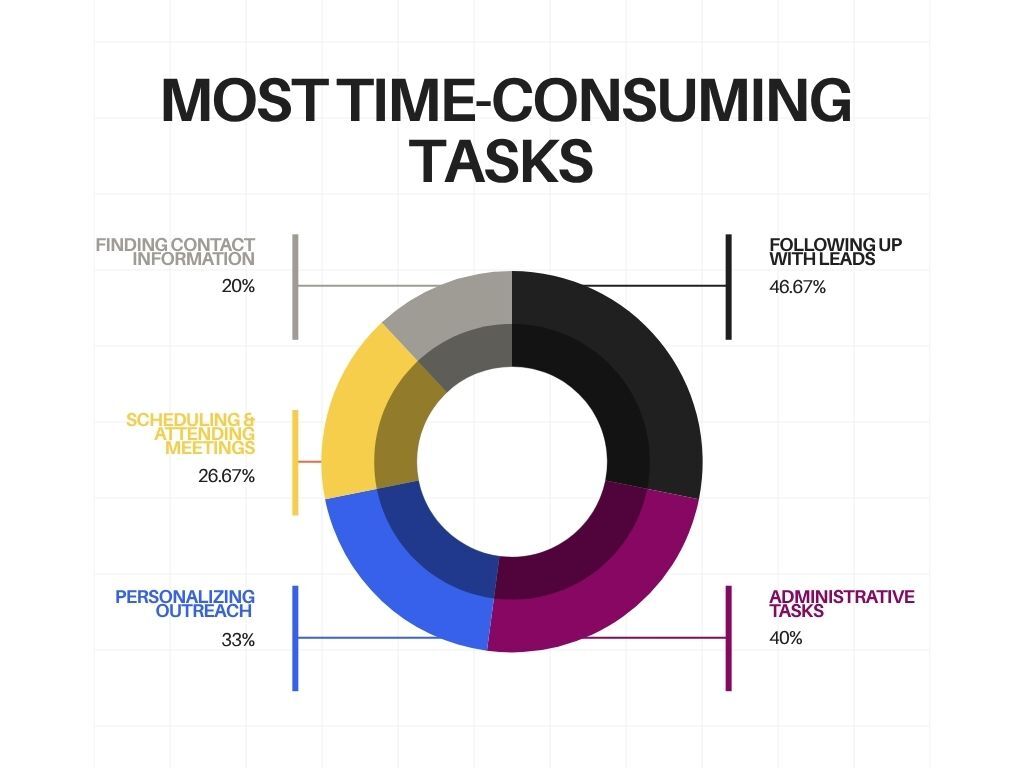
In 2025, 40% said personalizing outreach at scale was one of their biggest obstacles to hitting quota. Now in 2026, 46% said following up with leads was one of the most time-consuming parts of their job, while 40% pointed to administrative work like CRM updates and reporting. AI is cutting back on that manual load so reps can spend more time focused on conversations, pipeline, and closing.
The takeaway is clear: sales teams that win won’t just use AI to do more outreach, they’ll use AI to build smarter, faster, more targeted ways to generate pipeline.
Where AI Is Delivering the Most Value in Sales
AI is helping reduce that manual load so reps can spend more time focused on conversations, pipeline, and closing.
The appetite for greater AI support with repetitive prospecting tasks is growing fast. In 2026, 80% of respondents said they are already using AI in their sales workflow, and 53% said AI is very effective in supporting that workflow. Just as important, excitement around workflow automation jumped from 10% in 2025 to 46% in 2026, signaling a major shift toward tools that help sales teams move faster with less manual effort.
What we’re walking away with: AI is proving most valuable when it helps sales teams do the work that drives the sales pipeline — finding the right leads, building better outreach, and removing the friction that slows prospecting down.
Why This Matters Now
The shift happening in sales isn’t just about AI adoption; it’s about how quickly teams are starting to trust AI to improve pipeline decisions. That shift matters because sales pros, small business owners, and lean teams are under constant pressure to generate more revenue without adding more manual work.
One of the clearest signals in the data is how much confidence has grown around AI’s ability to help identify the right prospects. In 2025, 37% of respondents said they would rely on AI if it could predict a prospect’s likelihood to buy with 90% accuracy. In 2026, that number jumped to 77%. That is a major change in mindset, and it points to a growing demand for tools that help teams prioritize faster, prospect smarter, and spend more time on real opportunities.
At the same time, AI is becoming increasingly important for smaller and leaner teams trying to compete with larger organizations. In 2025, 52% of respondents said AI helps smaller sales teams compete with larger ones, and 46% said the same in 2026. That makes AI more than a productivity tool; it’s a way to scale output, improve focus, and create more pipeline without increasing headcount.
The bottom line is simple: sales teams can no longer afford to treat lead generation as a manual, time-heavy process. The teams that move first on smarter AI prospecting, better lead prioritization, and more efficient outreach will be better positioned to grow pipeline and win more sales.
"Willingness to rely on AI for 90%-accurate buyer prediction rose from 37% in 2025 to 77% in 2026."
Want All the Report Data?
Want to see more year-over-year shifts in AI usage? Get the complete 2026 State of AI in Sales report and explore the latest trends and headline stats shaping how modern sales teams generate leads, improve prospecting, and build sales pipeline with AI.
The biggest stat change in the entire survey data was interest in workflow automation with AI as the most exciting advancement jumping up 5x over last year going from 10% in 2025 to 46% in 2026. If you're not prepared with AI agents you could be missing out on deals.
Seamless Can Improve Your AI Prospecting
Learn more about how Seamless can help build quality sales pipeline and generate more leads. Talk to a rep today to see a demo or try it free with 50 credits by signing up now.
Download the full report now >>>