For nearly a century Humans have depicted AI in various forms from robots in comics to entire races in movies and tv shows, but it's usually in aspects that marvel capabilities of people from power to processing. When many think about AI it's usually doing wonderous advances for medicine or technology, but in fact it's great for sales.
Back in 2016, McKinsey predicted that emerging AI-powered technologies were on the fast track to radically transform sales productivity. Flash forward to 2025, and that prediction has materialized. Now, sales reps everywhere are leaning into AI-driven tools to streamline tasks that once consumed whole workdays with mundane tasks.
For sales managers, integrating AI means more than nudging your SDRs to use generative AI to write their next LinkedIn campaign (they’re already doing that).
Today’s sales teams are deploying prospecting tools to dramatically economize their workflows and optimize every stage of their sales pipeline.
If you’re just getting up to speed, don’t panic—but take note: Sales teams adopting AI early are gaining a real strategic edge. Getting fluent in the capabilities of these tools—and knowing how to use AI for sales prospecting in particular—will help ensure you stay competitive with where the industry is headed.
What Does AI Mean for Sales Prospecting?
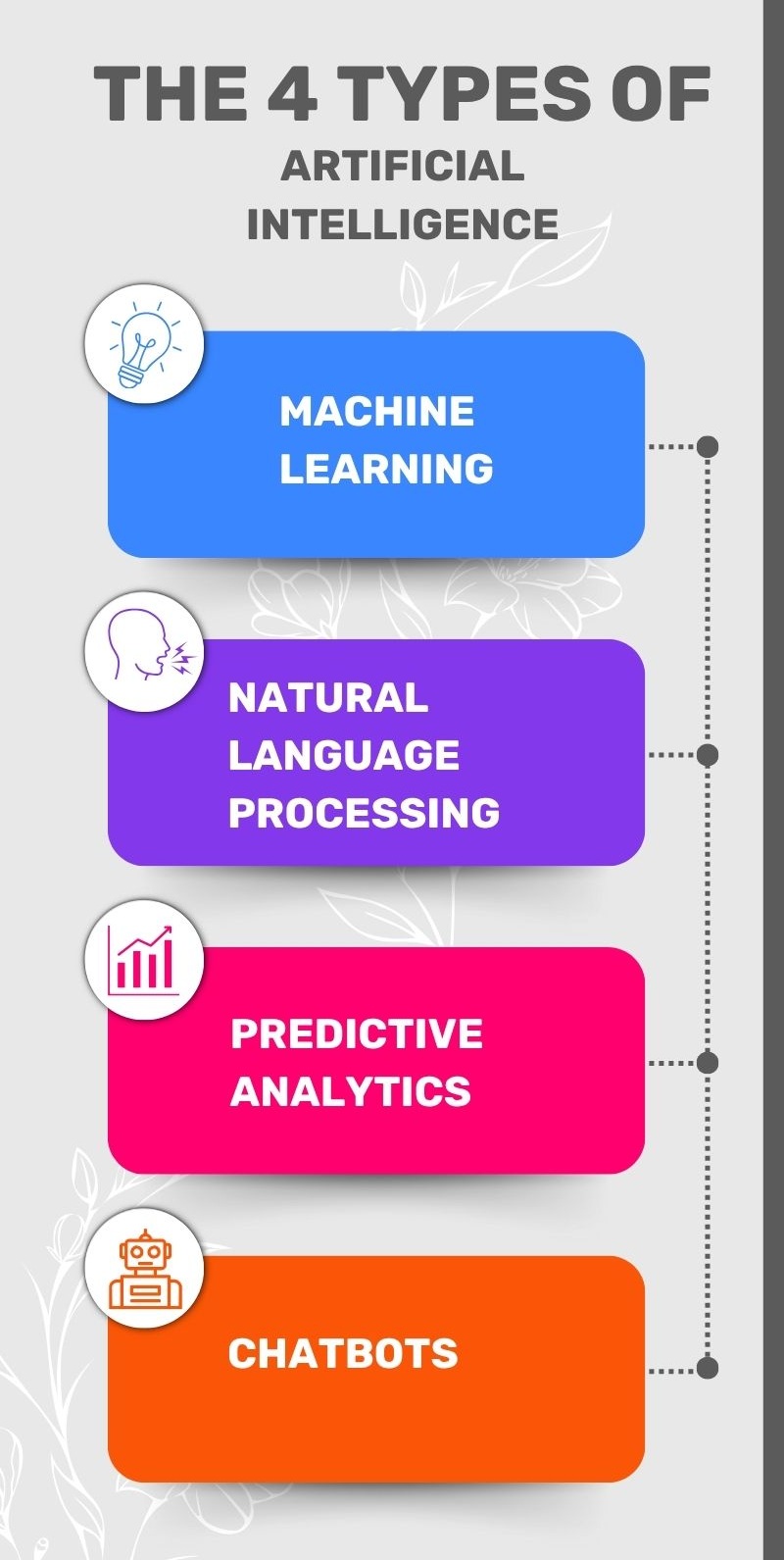
AI is reshaping sales prospecting with robust tools and strategies that will drive better outcomes for companies. AI is a broad term with many facets, but in the context of sales prospecting, it could refer to any or all of the following LLM technologies:
- Machine learning
- Natural language processing
- Predictive analytics
- Chatbots
For sales professionals, these tools have the potential to transform how the industry identifies, qualifies, and engages prospects, bringing more intelligence, precision, and scalability to each step of the process.
For example, AI lead generation is about automating the discovery of high-potential customers with scoring or filtering, improving the speed and quality of the entire prospecting cycle.
Traditionally, much of the grunt work has been manual and tedious—from research to list compilation—while strategic decisions have often been speculative, whether developing IDPs or drafting cold outreach emails.
AI tools empowers sales pros to automate these time-intensive, resource-heavy tasks, shifting sales reps away from brute-force list generation and enabling more insight-driven, priority-led, and personalized engagement efforts.
Why Use AI in Prospecting?
Traditional prospecting workflows come with some familiar pain points:
- Manual research absorbs hours gathering company and contact data
- Lagging response times cause missed opportunities and lost momentum
- Repetitive groundwork drains energy that could be spent on live, person-to-person conversations
AI sales tools can address all of these obstacles, and the benefits go beyond using ChatGPT to draft outreach emails and LinkedIn messages. The advantages include:
- Speeding up response times – AI enables real-time profile enrichment and alerts when a prospect shows signs of interest. This saves sales reps time between identifying a prospect and engaging with them meaningfully.
- Researching prospects and IDPs – AI tools aggregate behavioral, technographic, and firmographic data to enrich contact records, shedding more light onto each lead’s triggers and motivations.
- Enhancing employee autonomy and energy – By letting AI tools handle research and personalization, sales reps can focus on taking discovery calls, building relationships, and having real conversations with leads.
Moreover, sales professionals today can’t afford not to use AI. McKinsey reports that top-performing B2B sales teams have seen a 10 to 15% boost in efficiency from using automation tools. In other words, your competitors are already using AI, shortening sales cycles, gaining more face time, and improving sales outcomes as a result.
But how exactly do you use AI for sales prospecting?
Step 1: Automating Lead Research With AI
AI integration starts at the first stage of the sales pipeline: lead research and enrichment.
AI tools collect data from both internal CRM systems and external sources—like company websites, news, and social signals—to build strong prospect profiles. They’re able to detail:
- Firmographics like industry, size, and revenue
- Technographics like the tools and systems they rely on
- Intent signals like searches, content engagement, and buying triggers
- Contact details
Automating these initial processes reduces manual research while improving accuracy and depth. By combining AI-powered prospecting tools with existing CRM integrations, sales reps can optimize their efforts, improve customer engagement, and generate higher-quality leads for their business. It also arms sales and marketing teams with a more dimensional, nuanced, and unified view of their prospects: their drives, their triggers, and their points of friction.
As a result, AI-led predictive analytics can help reveal best-fit prospects, allowing sales teams to reimagine and reinvigorate the customer journey—no guesswork needed.
Step 2: Personalizing Outreach at Scale
Before AI, sales reps faced a catch-22: Toil for hours over personalized messages that might not get seen, or simply hit “send” on a generic campaign that likely won’t be as effective.
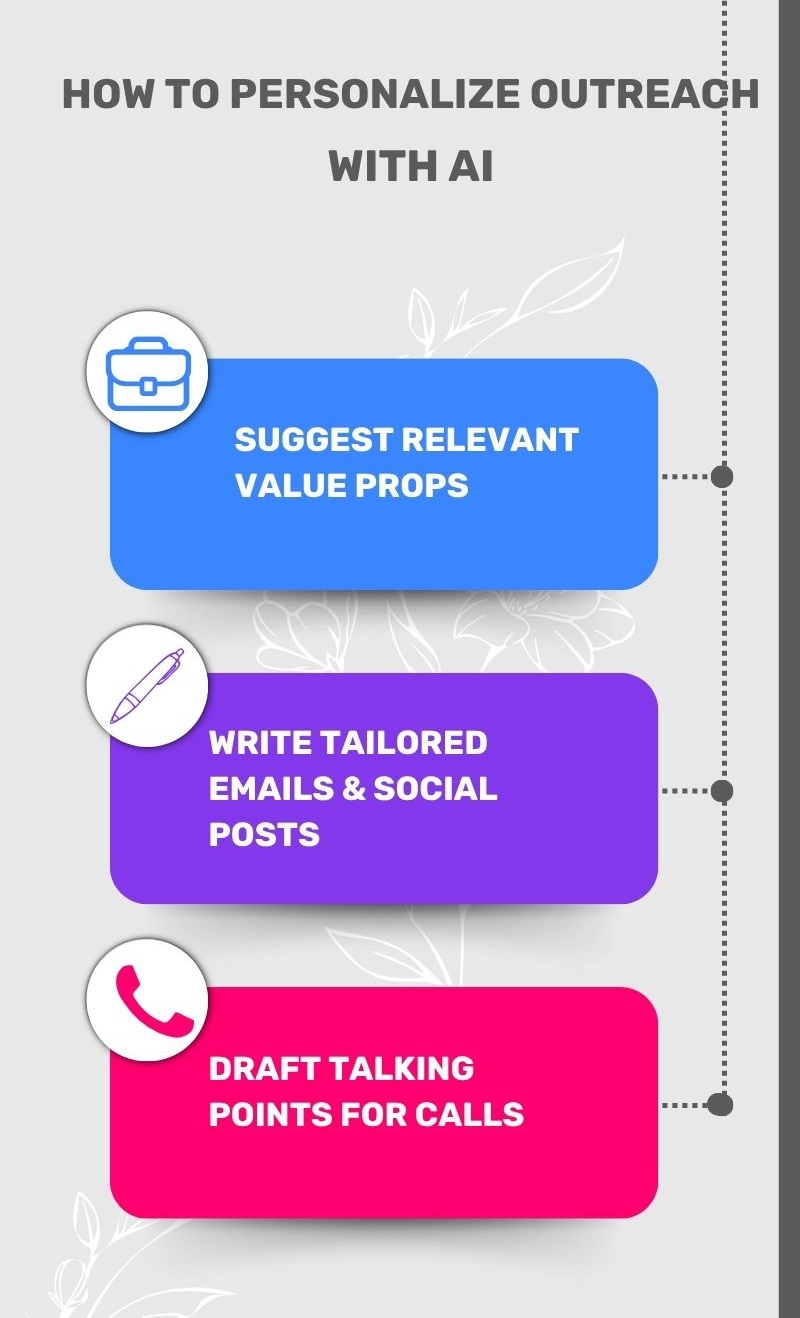
AI can help eliminate that trade-off by personalizing outreach at scale. Tools can be used to:
- Suggest tailored, relevant value propositions
- Draft personalized sales messaging for email and social
- Recommend talking points or questions for calls
Sales reps can even integrate chatbots and AI assistants into their workflows to refine pitches, unearth new value propositions, or strengthen objection-handling scripts. These tools also provide personalized offers and prompts that help sales reps refine their messaging and better connect with each target prospect. Whatever it’s used for, AI helps SDRs and AEs scale without sacrificing relevance.
Step 3: Prioritizing Prospects With AI Lead Scoring
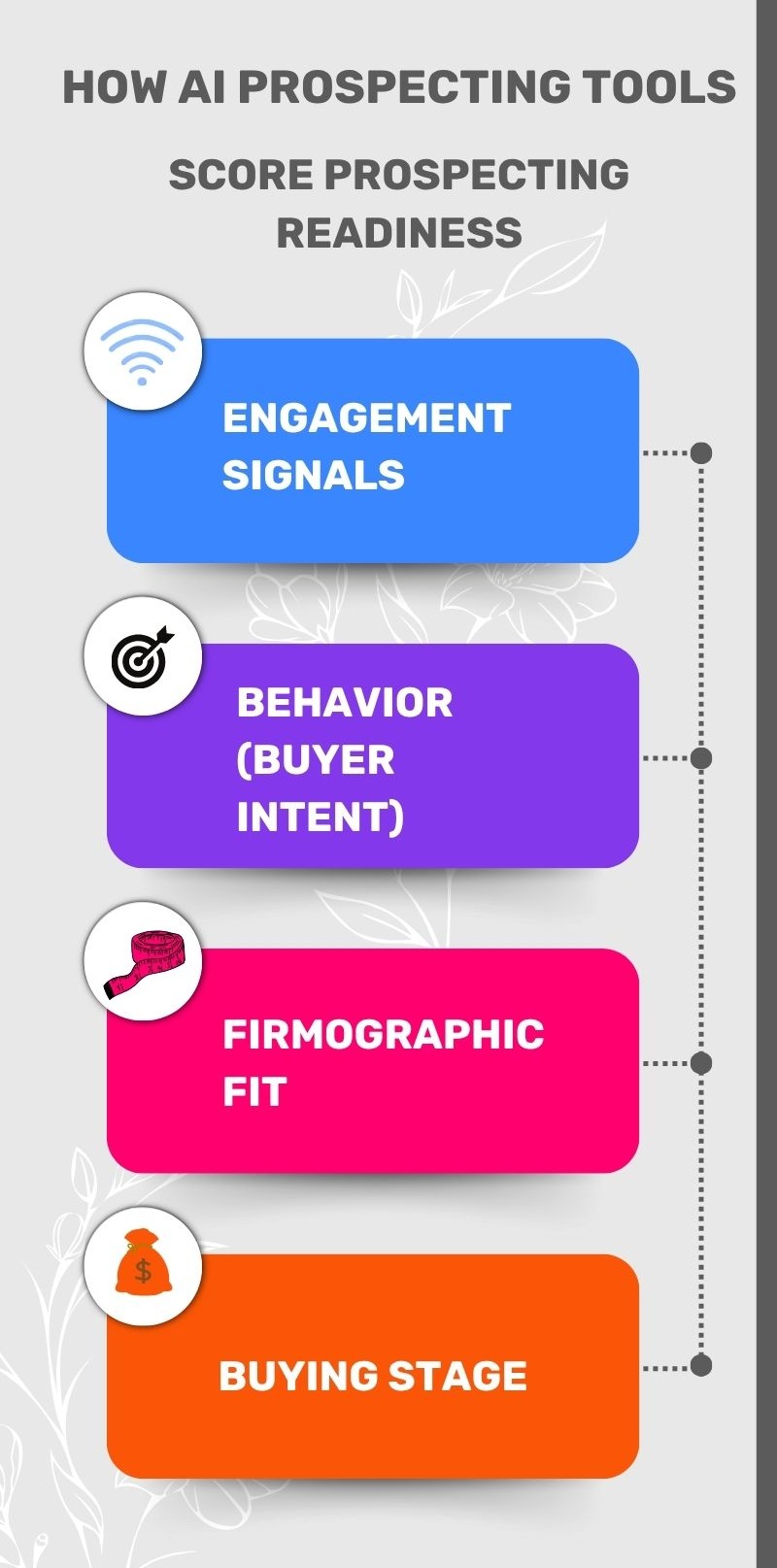
Once leads have been identified, AI lead generation tools analyze data to determine which are the most qualified. AI-driven lead scoring looks at buyer engagement, company fit, and intent signals to rank opportunities. That’s because AI prospecting tools can score prospect readiness based on key factors such as:
- Engagement signals
- Behavior
- Firmographic fit
- Buying stage
AI lead generation also supports this process by continuously identifying new prospects that align with your ideal buyer profile, ensuring your teams always have a steady pipeline of qualified leads to pursue.
This capability allows SDRs and AEs to focus their daily and even hourly efforts on only promising, high-priority contacts. The result is a reduction in wasted effort, time, and resources and an improvement in overall conversion efficiency.
Step 4: Using AI to Improve Follow-Up
Follow-ups often decide whether a lead converts or fades away. AI prospecting tools ensure no customer is forgotten by scheduling reminders, triggering chatbot re-engagement, and suggesting the best next step based on real-time information.
AI tools help ensure no lead slips through the cracks by:
- Setting up follow-up reminders for sales reps
- Triggering chatbots to re-engage leads that have cooled off
- Suggesting the best next steps based on prospects’ real-time behavior
- Predicting optimal timing for responses
Intelligently automating follow-up timing, sales teams can stay persistent without overwhelming leads, aligning cadence with buyer behavior rather than arbitrary schedules.
Step 5: Using AI for Sales Forecasting
Forecasting is the final frontier where AI tools can help move prospects into the sales pipeline. Combining AI with current CRM systems, sales teams can analyze their pipeline holistically, looking at:
- Historical conversion rates
- Activity levels
- Deal characteristics
- Lead qualification signals
All of these insights can help guide resource allocation, inform future outcome predictions, and identify formerly hidden revenue opportunities. Sales managers can use these predictions to decide how many AEs are necessary, which verticals to focus on, and which leads to either push or let go.
Over time, these insights feed back into SDR training, enabling continuous optimization. When integrating AI into forecasting, sales teams can adopt a less reactive posture in favor of a proactive one grounded in real-world data.
Common Pitfalls When Using AI in Prospecting
Despite the benefits, there are several dangers and drawbacks of integrating AI, which can easily introduce sales teams to more problems than efficiencies. Some common mistakes to be aware of include:
- Overdependence on automation – AI should never replace human judgment entirely, as over-automating outreach can easily cede good standing with prospects. As McKinsey reports, only about ⅓ of sales-related tasks can be reliably automated—and prospects still want human interaction and trust with businesses. As such, relationship-building should remain strictly human, even in the era of AI.
- Sub-par data inputs – AI tools are only as strong as their inputs. If your CRM data is faulty, out-of-date, poorly segmented, or missing key fields (e.g. role, email validity, behavior signals), the resultant AI-driven enrichment and scoring won’t hold up either.
- Lack of oversight – Without plans or systems to measure your AI tools’ performance, underperformance can easily go unnoticed. To stay out of the woods, be sure to establish KPIs and review processes to ensure your tools continue generating value.
- Neglecting the human touch – AI is excellent for assisting with outreach. But the most trusted responses are still human-to-human. If your sales reps rely purely on AI-crafted messages without exhibiting empathy or relational intelligence, your outreach will feel stiff and formulaic rather than sincere.
- Under-training the whole sales team – AI is a tool, and humans need to be taught how to use it. Without adoption—whether due to lack of buy-in or a team’s resistance to changes in their workflows—the tool’s value quickly diminishes. Research shows that organizations that invest in AI training are around 43% more successful than those that don’t.
- Setting expectations too high – One survey found that 80% of companies using generative AI weren’t yet seeing bottom-line gains just yet. While the technology is still maturing, the payoff is expected to grow as it becomes more embedded in daily workflows.
The takeaway here is that AI isn’t a crutch or a set-it-and-forget-it solution.
AI should enhance, not replace, human interactions. The most effective strategies balance automation with authentic relationship-building. Efficient strategies ensure relationship-building stays paramount. It takes vested planning to implement AI thoughtfully, with clean data, clear oversight, and ongoing human involvement. Used in this way, AI can compound your team’s performance, providing them with smarter tools to help them do their best work.
Turning AI Into a Sales Advantage
AI isn’t replacing people—it’s helping sales prospecting teams work smarter. Data consistently shows that authentic, trust-based relationships remain the backbone of successful sales. What these tools are doing is empowering sales professionals by automating tedious, repetitive tasks, surfacing sharper insights, and freeing up time for what matters most: human connection.
Whether you’re seeking valid, real-time contact data or a better way to locate qualified leads, Seamless.AI delivers a range of intelligent tools to sales professionals at every level of the ladder. With coverage spanning more than 121 million companies and domains, Seamless.AI simplifies the prospecting groundwork so you can focus on building relationships that convert.
Start turning missed opportunities into wins and explore Seamless.AI’s suite of sales solutions now.
Sources:
McKinsey & Company. Why salespeople need to develop ‘machine intelligence’. https://www.mckinsey.com/capabilities/growth-marketing-and-sales/our-insights/why-salespeople-need-to-develop-machine-intelligence
Forbes. How AI Is Changing Sales And Customer Service Teams. https://www.forbes.com/sites/allbusiness/2024/09/27/how-ai-is-changing-sales-and-customer-service-teams/
McKinsey. An unconstrained future: How generative AI could reshape B2B sales. https://www.mckinsey.com/capabilities/growth-marketing-and-sales/our-insights/an-unconstrained-future-how-generative-ai-could-reshape-b2b-sales
RAIN Group. An Introduction to Using AI in Sales Prospecting. https://www.rainsalestraining.com/blog/using-ai-in-sales-prospecting
Harvard Division of Continuing Education. AI Will Shape the Future of Marketing. https://professional.dce.harvard.edu/blog/ai-will-shape-the-future-of-marketing/#Predictive-Analytics-and-Forecasting
Harvard Business Review. How AI Is Changing Sales. https://hbr.org/2018/07/how-ai-is-changing-sales
Forbes. How AI Is Changing Sales And Customer Service Teams. https://www.forbes.com/sites/allbusiness/2024/09/27/how-ai-is-changing-sales-and-customer-service-teams/
McKinsey. The future of B2B sales is hybrid. https://www.mckinsey.com/capabilities/growth-marketing-and-sales/our-insights/the-future-of-b2b-sales-is-hybrid
Iterable. 15+ Stats About Achieving ROI From AI Marketing. https://iterable.com/blog/15-stats-roi-ai-marketing/?utm_source=chatgpt.com
McKinsey. The state of AI: How organizations are rewiring to capture value. https://www.mckinsey.com/capabilities/quantumblack/our-insights/the-state-of-ai?utm_source=chatgpt.com