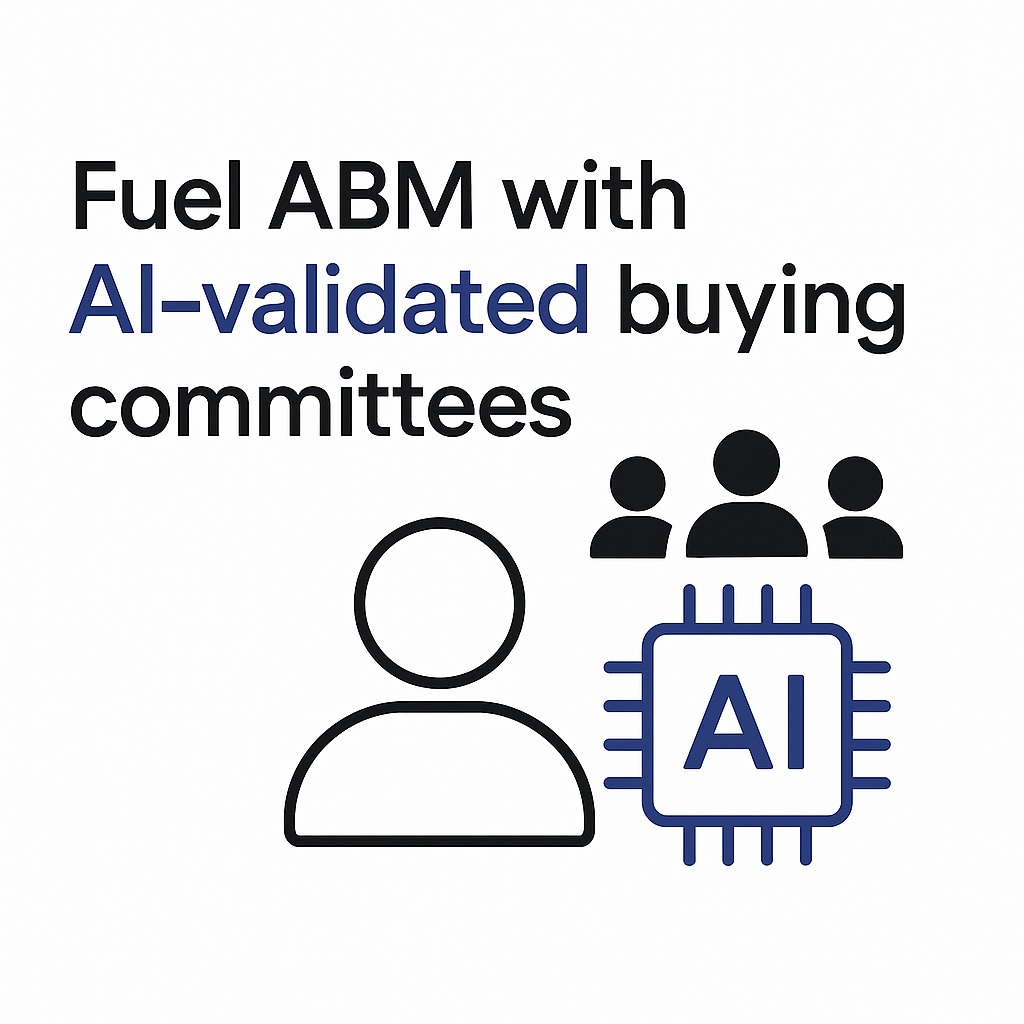
If ABM is your strategy, then accurate and current contact data is your fuel. The fastest way to improve MQAs, meetings, and pipeline is to expand and refresh buying-committee coverage across your target accounts—then activate that data consistently across ads, email, and sales rotrations.
Here we'll show you how using an accurate contact finder from Seamless.AI can boost capabilities and maximize return.
Key points: TLDR
- Start with clarity: define your ICP (ideal customer profile) and build a TAM (total addressable market) that’s tiered (Tier 1/2/3). For Tier 1 accounts, aim for 4–8 validated contacts across core roles: economic buyer, champion, technical evaluator, security/compliance, and procurement.
- Use an AI B2B contact finder to close coverage gaps fast: find net-new stakeholders, validate emails/phones, tag buying roles, and push clean data into your CRM/MAP for activation.
- Quality beats quantity: target an email validity rate above 92%, direct-dial availability of 30–50% on priority roles, and a refresh cadence of 60–90 days for Tier 1 accounts (quarterly is a practical starting point).
- Activate everywhere your buyers are: sync contacts to LinkedIn Matched Audiences, personalize nurture tracks by role and trigger, and enable SDRs with multithreaded outreach tied to the same data.
- Measure the pipeline chain, not just clicks: Coverage → Reach → Engagement → MQAs → Opportunities. Monitor role coverage %, bounce rate, matched-audience size, reply rates, and multi-thread depth per account.
- Stay compliant and deliverable: enforce opt-out syncs, regional rules, platform policies, and suppression lists; validate data before every send and refresh.
- Quick win to prove value: run an account coverage audit on your top 100 Tier 1 accounts. Marketing teams typically uncover 2–4 missing roles per account and lift MQAs within 1–2 cycles after closing those gaps. Results vary by industry and list quality.
Take action: Run a free account-based market coverage check in Seamless.AI to identify gaps in your buying committee, uncover missing decision-makers, and validate contact accuracy before launching outreach.
Why contact data is the fuel of ABM
ABM, which stands for account based marketing, fails less often because teams picked the wrong accounts—and more often because they can’t consistently reach the right people within the right accounts. Thin buying-committee coverage, stale emails, and single-threading are the hidden drag on MQAs and deal velocity.
An AI B2B contact finder changes the slope of that curve by rapidly expanding, validating, and refreshing the exact contacts you need, then routing them into your activation channels. Think of it like having the world's biggest rolodex organized at your finger tips. It's a sales rep's dream come true.
The four dimensions of ABM-ready contact data
Most ABM programs don’t fail on account selection; they fail because teams can’t reliably reach the full buying group (coverage), send to valid inboxes (accuracy), keep up with job changes (recency), or run campaigns responsibly (compliance). These four pillars directly address those failure modes.
1. Coverage: Do you have the full buying group? Role coverage is the percentage of required roles with at least one validated contact.
Example formula: role coverage % = (number of required roles with a validated contact ÷ total required roles) × 100. Target 80%+ on Tier 1 accounts.
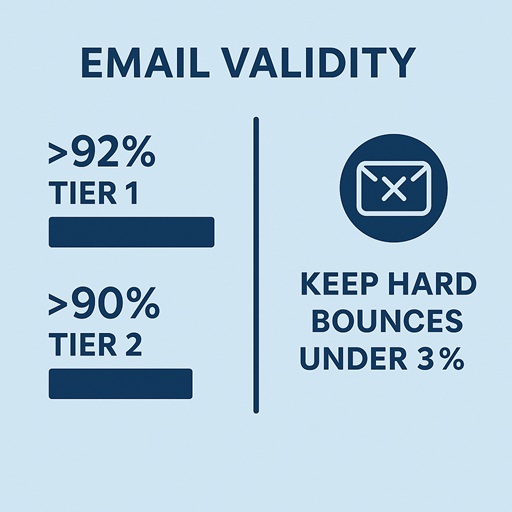
2. Accuracy: Are the contact details valid today? Track email validity %, hard-bounce rate, and direct-dial success. Aim for >92% email validity and <3% hard bounces on Tier 1 outreach.
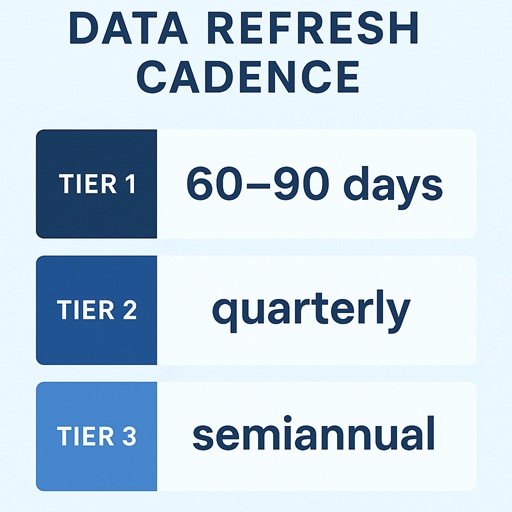
3. Recency: How fresh is the data? B2B data decays quickly due to job changes and reorgs. Refresh Tier 1 contacts every 60–90 days, Tier 2 quarterly, Tier 3 biannually.
4. Compliance: Are you collecting and using data responsibly? Maintain lawful basis, honor opt-outs, sync do-not-contact fields, and align with regional rules and platform policies. Enforce data minimization and clear suppression logic.
How better data multiplies ABM results
We've all carried a quota—better data is the difference between grinding and winning. When you expand from one or two champions to four to eight validated stakeholders per account, your reachable audience explodes without going spray-and-pray. Verified emails keep bounces and spam signals down so more messages actually land in inboxes, which means more replies and more meetings booked.
On deal speed, multithreading early pulls the economic buyer, security, and end users into the loop before objections pile up, so internal consensus happens faster and opportunities open sooner. And when records are role-tagged with direct dials and recently validated, connect rates jump and handoffs feel smooth—fewer “who is this?” moments, more qualified conversations, and cleaner pipeline.
Bottom line: tighter data gets you in front of the right people sooner, books more meetings, and moves deals across the line faster.
Practical benchmarks to guide your program
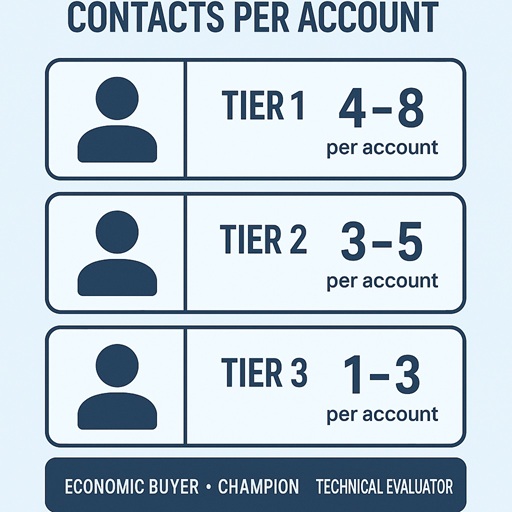
Contacts per account: 4–8 for Tier 1, 3–5 for Tier 2, 1–3 for Tier 3 (prioritize economic buyer, champion, technical evaluator).
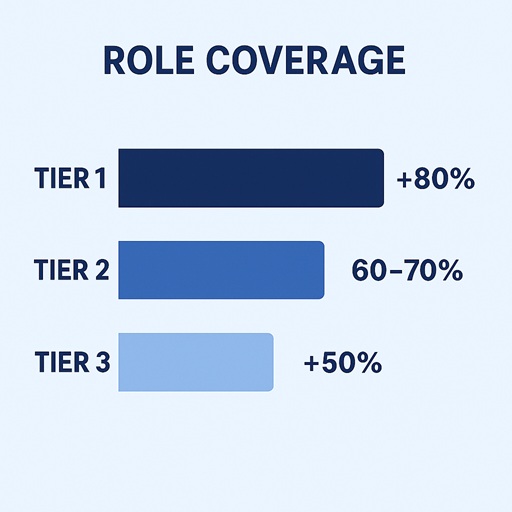
Role coverage: 80%+ on Tier 1, 60–70% on Tier 2, 50%+ on Tier 3.
Email validity: >92% for Tier 1, >90% for Tier 2; keep hard bounces under 3%.
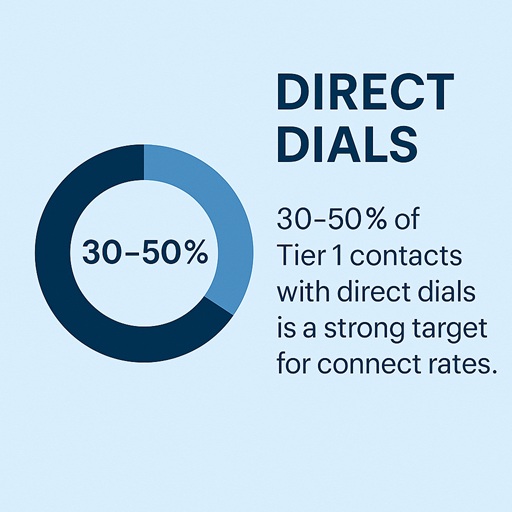
Direct dials: 30–50% of Tier 1 contacts with direct dials is a strong target for connect rates.
Refresh cadence: 60–90 days for Tier 1, quarterly for Tier 2, semiannual for Tier 3.
Compliance hygiene: 100% opt-out sync and suppression coverage before every activation; document lawful basis by region.
5 ways an AI B2B contact finder fits in your ABM engine
1. Expansion: Identify missing stakeholders by function, seniority, and title variants; map them to buying roles.
2. Validation: Verify emails and phones pre-activation; reduce bounces and wasted ad spend.
3. Enrichment: Normalize titles, departments, seniority, and buying roles for precise segmentation.
4. Routing: Push cleaned, role-tagged contacts to CRM/MAP and ad platforms; enable SDRs with direct dials and notes.
5. Refresh: Automate periodic revalidation and job-change alerts to keep your ABM audiences current.
Example ABM impact scenario with contact finder from Seamless.AI
Before AI contact finder: 42% role coverage on Tier 1; small matched audiences; high bounce rate; single-threaded outreach.
After closing gaps with an AI contact finder: 86% role coverage, 2–3× larger matched audiences, hard bounces <3%, multithreaded outreach to 5+ stakeholders. Teams often see MQAs rise meaningfully in 1–2 program cycles once coverage and deliverability improve. Actual results vary by list quality, messaging, and channel mix.
For a demo on how this could impact your sales reach out to one our experts or get 50 free credits to check it out for yourself.