GTM (go-to-market) teams these days do not lose deals because they lack talent. They lose deals because of bad timing, zero context, and no accurate data.
Market intelligence tools help sales, marketing, and revenue teams identify the right accounts, prioritize buyers based on real signals, and tailor messaging using real-world insights like hiring trends, funding events, tech stack changes, and intent behavior.
This guide breaks down the top market intelligence tools GTM teams are using in 2026, the tasks each tool is best at, and how to choose the right platform based on your goals. You will also see why Seamless.AI is increasingly becoming the preferred choice for teams that care about speed, accuracy, and ROI.
What Market Intelligence Means for GTM Teams
Market intelligence is the process of collecting and using information about:
- Companies: size, industry, revenue, growth signals, tech stack, org structure
- People: titles, responsibilities, contact data, reporting structure
- Timing Signals: hiring, funding, leadership changes, expansion, intent activity
- Competitive Context: which vendors they use, which categories they are evaluating

GTM teams use this intelligence to improve outcomes across the funnel:
- Sales uses it to build targeted lists, personalize outreach, and prioritize accounts
- Marketing uses it to refine ICPs, build segments, and improve campaign conversion
- RevOps uses it to keep CRM data clean, enrich records, and reduce wasted spend
The best tools do not just provide data. They make it easy to make that data actionable across the entire GTM workflow.
What to Look for in a Market Intelligence Tool
Before looking at vendors, it helps to define what “good” actually looks like. High-performing go-to-market teams typically evaluate tools based on:
Data accuracy & freshness
If the data is stale, your team will end up wasting precious time and credibility (that’s hard to get back). Accuracy is the foundation of everything.
Workflow speed
If reps need multiple steps to find a contact, verify it, enrich it, and push it into the CRM, adoption drops. When it comes to workflow, you have to keep it simple.
Depth of intelligence
The best platforms provide more than email and phone numbers. They include firmographics, org insights, and buying signals.
Integrations & automation
If the platform does not integrate cleanly with popular tools like Salesforce, HubSpot, Outreach, Salesloft, or your data warehouse, RevOps will be forced to do manual work, which is a major time-waster.
Explore: Seamless.AI integrations
Total cost & flexibility
Many teams overpay for “enterprise” platforms when they only need a subset of features to drive revenue. Take an honest look at your tech stack and do a pulse check. Maybe there are areas that could be pared down.
12 Best Market Intelligence Tools for GTM Teams
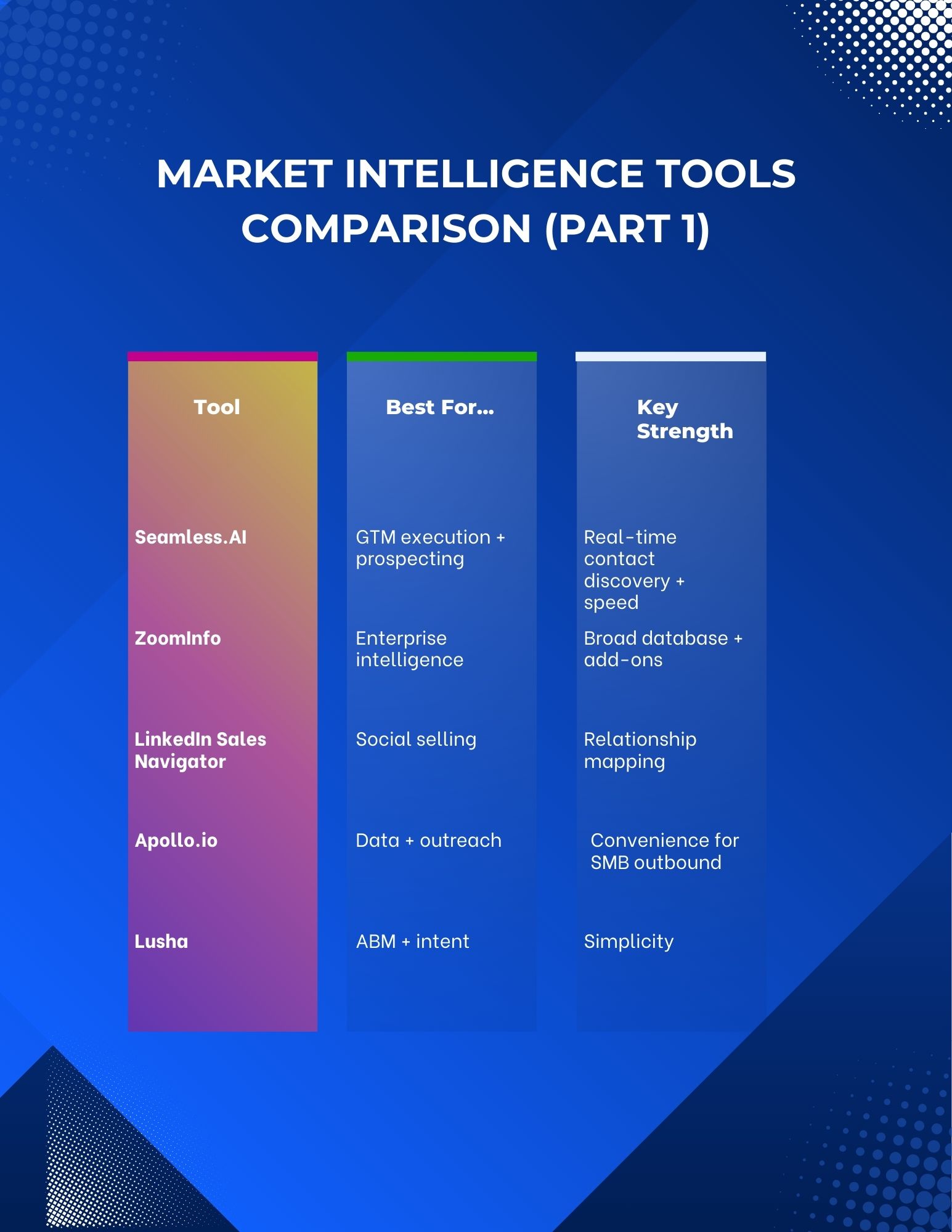
Seamless.AI (Best Pick for GTM Prospecting and Real-Time Intelligence)
Seamless.AI is purpose-built for GTM teams that want to move fast without sacrificing accuracy. Our platform combines real-time contact discovery, deep account insights, and workflow-ready enrichment so teams can go from “target list” to “live outreach” without delays and without ever leaving the app.
Key strengths:
- Real-time search for verified B2B contacts
- Strong coverage across industries and company sizes (not just enterprises like competitors)
- Built for automated list-building, outbound prospecting from directly in the app, and pipeline generation
- Designed to support and align sales, marketing, recruiting, and RevOps
- API access and scalable enrichment options to put your lead generation on autopilot
Why Seamless.AI stands out:
Most platforms are cluttered with clunky features, but they fail to deliver results. Seamless.AI is designed around execution. The goal is not just intelligence. The goal is faster pipeline creation and higher conversion by providing teams with actionable data they can start using right away.
Best for:
Sales teams, marketing ops, recruiting teams, and any GTM team that depends on high-quality contact data and speed.
ZoomInfo (Enterprise-Scale GTM Intelligence Platform)
ZoomInfo is widely known as an enterprise solution for contact data, company insights, and intent signals. If you run a large org, and you’re looking for a centralized source for intel that can be used companywide, this is a solid choice.
Key strengths:
- Broad database and company profiles
- Intent and engagement-related add-ons
- Often used in enterprise GTM stacks
Best for:
Enterprise teams with large budgets and dedicated ops resources.
Considerations:
Onboarding can be time-consuming and complicated. Pricing is also difficult to navigate. And often, there are so many features that teams don’t end up using, the ROI you get doesn’t always justify the price and the stack bloat.
LinkedIn Sales Navigator (Best for Relationship Mapping and Social Selling)
Sales Navigator gives reps advanced search and filtering across LinkedIn profiles. It is especially useful for relationship-driven selling and account mapping.
Key strengths:
- Strong for identifying stakeholders and org structures
- Great for warm introductions and mutual connections
- Helpful for account research
Best for:
Enterprise and mid-market teams focused on strategic account selling.
Considerations:
Sales Navigator does not replace a true market intelligence platform. It does not provide verified direct contact data at the same depth, and it requires additional tools for enrichment and workflow automation.
Apollo.io (Best for Teams Wanting Data + Outreach in One Platform)
Apollo combines contact data, prospecting, and sales engagement in a single, all-in-one platform. Many SMB and mid-market teams use it to consolidate tools.
Key strengths:
- Prospecting + sequencing
- Useful for smaller teams building outbound motions
- Workflow convenience
Best for:
SMBs looking for a single tool to run outbound.
Considerations:
When a platform tries to be both the system of record for outreach and the system of record for intelligence, teams sometimes run into limitations with accuracy, coverage, or enrichment flexibility at scale.
Lusha (Best Lightweight Contact Data Tool for SMB Sales Teams)
Lusha is a popular sales contact data provider that focuses on simplicity. It is often used by SMBs and smaller sales teams that want a quick way to pull contact info while browsing LinkedIn or researching accounts.
Key strengths:
- Easy to use
- Fast access to contact data
- Good entry-level option for small teams without a ton of budget
Best for:
Small sales teams and early-stage companies.
Considerations:
For teams scaling outbound or requiring more advanced intelligence, integrations, and enrichment workflows, you may feel limited in what you’re able to do compared to more comprehensive platforms like Seamless.AI.
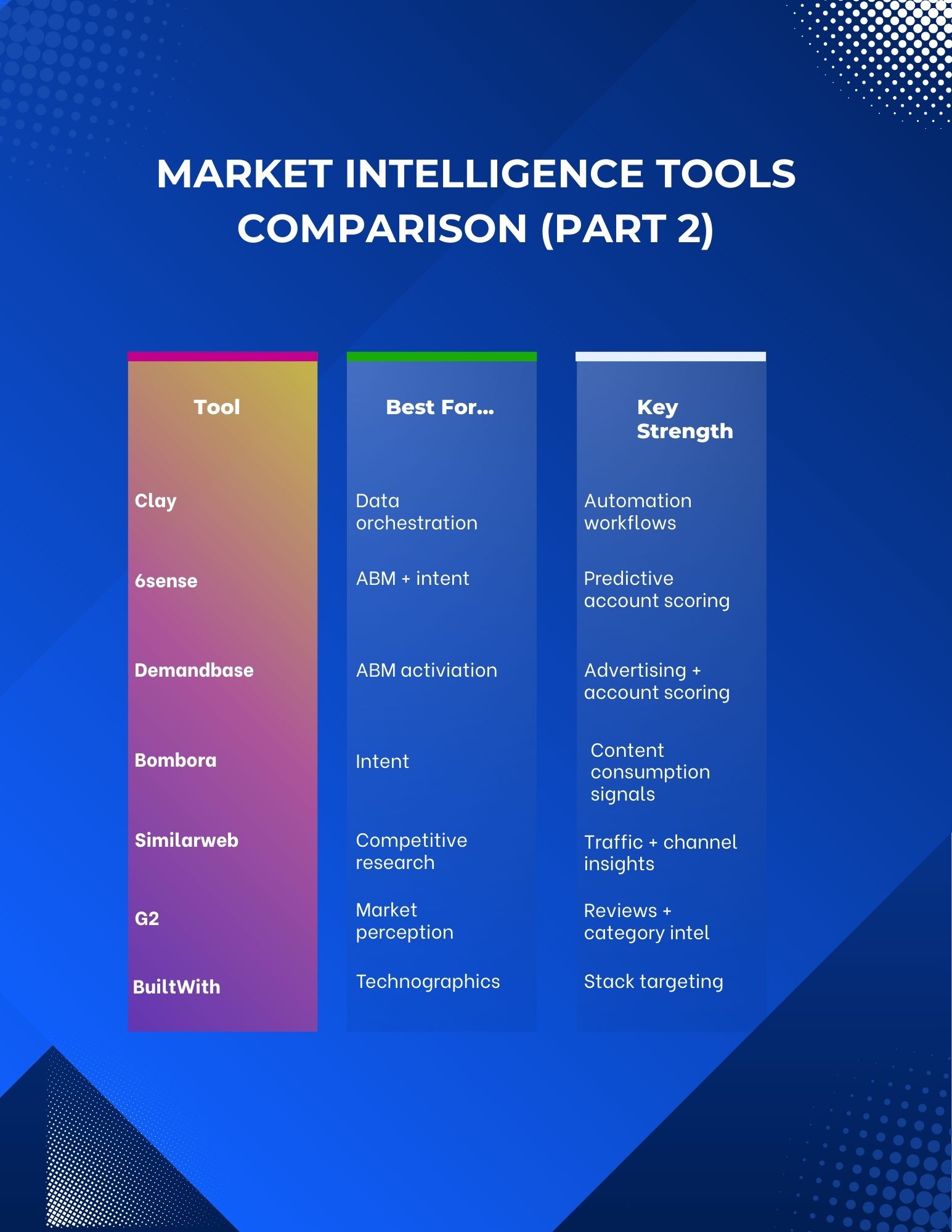
Clay (Best for GTM Data Orchestration and Workflow Automation)
Clay is a workflow engine for GTM teams that want to combine data sources, enrich records, trigger automations, and build lists using multiple providers.
Key strengths:
- Powerful enrichment workflows
- Can connect many data sources into one pipeline
- Great for RevOps and growth teams building custom prospecting systems
Best for:
Ops-heavy GTM teams and growth teams that want custom workflows.
Considerations:
Clay is best paired with a high-quality data provider. On its own, Clay makes your stack more powerful, but it does not replace the need for accurate real-time contact data.
6sense (Best for Enterprise ABM and Intent-Driven Account Targeting)
6sense is known for account-based marketing and intent modeling. It helps teams prioritize accounts based on signals and predictive scoring.
Key strengths:
- Intent and account scoring
- ABM campaign alignment
- Useful for enterprise marketing teams
Best for:
Enterprise ABM teams running account-based programs.
Considerations:
To activate insights, teams still need strong contact data and enrichment, which is why many pair it with a platform like Seamless.AI.
Demandbase (Best for ABM Advertising and Account Intelligence)
Demandbase focuses on ABM strategy, account identification, and advertising. It is strong for enterprise account targeting and B2B advertising execution.
Key strengths:
- ABM advertising capabilities
- Account segmentation
- Marketing activation
Best for:
Enterprise marketing teams.
Considerations:
Demandbase is typically not the primary tool for outbound contact discovery.
Bombora (Best for Intent Data and Content Consumption Signals)
Bombora is a well-known intent provider that tracks B2B content consumption patterns across a large network.
Key strengths:
- Strong intent signal data
- Useful for timing outreach and campaigns
- Works well with ABM strategies
Best for:
Marketing and sales teams that want better timing signals.
Considerations:
Intent data is most effective when paired with accurate contact intelligence so teams can immediately reach the right stakeholders.
Similarweb (Best for Digital Market and Competitor Web Intelligence)
Similarweb helps teams understand website traffic, channel performance, audience behavior, and competitor visibility.
Key strengths:
- Competitive traffic benchmarking
- Channel insights
- Market trend analysis
Best for:
Marketing strategy, competitive research, and growth teams.
Considerations:
This is not a prospecting tool. It is best used as a strategic layer.
G2 (Best for Category Insights and Competitor Comparison Signals)
G2 provides market insights through review data, category rankings, and buyer comparisons.
Key strengths:
- Competitive positioning insights
- Review-driven intelligence
- Useful for product marketing
Best for:
Product marketing and competitive enablement.
Considerations:
Not a replacement for contact intelligence or GTM execution tools.
BuiltWith (Best for Technographic Intelligence)
BuiltWith provides visibility into the technologies companies use. This is helpful for targeting accounts based on stack fit, migrations, and integration opportunities.
Key strengths:
- Tech stack visibility
- Strong for vertical-specific targeting
- Useful for partnership teams
Best for:
Sales teams with strong integration-based messaging and tech-led segmentation.
Considerations:
Works best when combined with a contact platform that can provide verified decision-maker data.
Market Intelligence Tools Comparison (Quick View)
Why Seamless.AI Is the Best Market Intelligence Choice for GTM Teams
A lot of tools can provide information. But the question is whether your team can use that information to create pipeline.

Seamless.AI is designed for execution, not dashboards. That is why it continues to win with GTM teams that care about:
- Faster AI-powered list building and targeting
- More accurate contact data and lower bounce rates
- Faster outbound launch cycles
- Better segmentation and enrichment
- Better ROI than “all-in-one enterprise” platforms
When market intelligence becomes part of daily workflow instead of a separate research task, your GTM team moves faster and wins more deals.
How to Build a Winning Market Intelligence Stack
Most teams do not need all 12 tools. They just need the right combination.
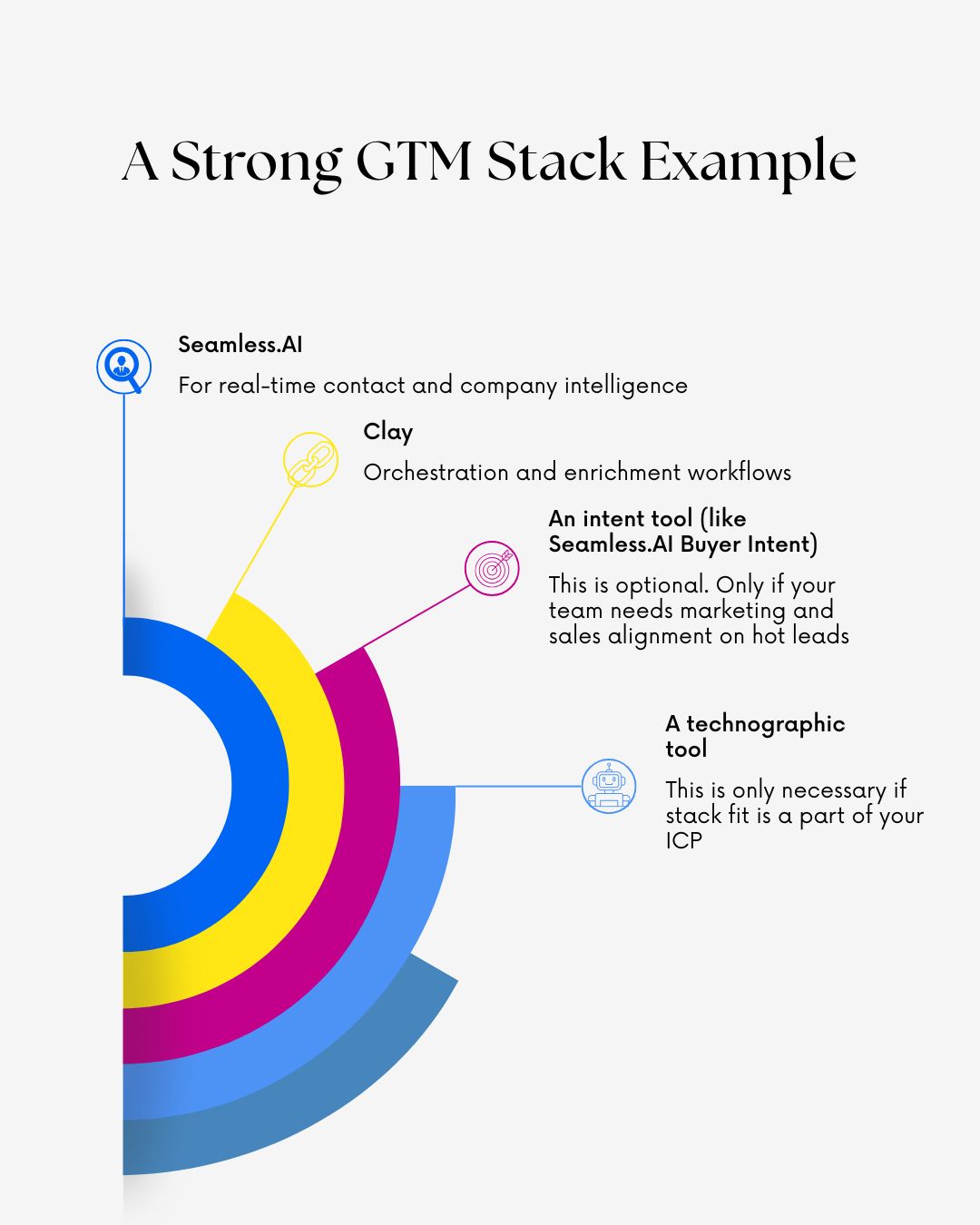
A practical modern stack looks like:
- Seamless.AI for contact and company intelligence (core system)
- Clay for orchestration and enrichment workflows (optional)
- One intent tool (only if your cycle benefits from it)
- One technographic tool (if your ICP depends on stack fit)
The simplest path to ROI is choosing a platform that makes GTM execution faster and more accurate from day one. Seamless.AI is built just for that. Choose tools that move deals forward, not dashboards, and your GTM team will feel the difference in pipeline, speed, and ROI.
Ready to see how Seamless can help you with a demo today. Start for free now to get 50 free credits.